 blog
How to Choose a Eurocraft Automotive Alternative for Luxury Cars
Quick Summary
A eurocraft automotive alternative should be judged on whether it can diagnose your specific European make correctly the first time, explain the repair clearly, and price the work honestly. Start by checking the shop's brand expertise, diagnostic equipment, and whether it provides itemized estimates and written warranty terms.
- Confirm the shop services your specific make and uses manufacturer-level diagnostic tools.
- Request itemized estimates that show diagnostic fees, labor hours per task, and part categories.
- Ask whether the diagnostic fee is credited toward the repair if you authorize the work.
- Get the shop's warranty terms in writing, including duration, coverage, and where it is honored.
- Keep every service receipt, since a complete maintenance record supports both warranty claims and resale value.
Table of Contents
- Why Owners Look for a Eurocraft Automotive Alternative
- Matching Shop Expertise to Your Specific Make
- Reliable Porsche Repair Shops in Longwood: What to Verify
- Comparing Pricing, Itemized Estimates and Labor Rates
- Parts, Warranty and Service Record Considerations
- Best Practices for European Car Maintenance Schedules
- Booking Your First Visit to Euro Specialist
- Frequently Asked Questions
How to Choose a Eurocraft Automotive Alternative for Luxury Cars
Last Updated: November 10, 2026
Why Owners Look for a Eurocraft Automotive Alternative
Most drivers aren't really shopping for a new shop. They want a shop that can diagnose a problem the first time, explain the repair in plain terms, and price the work honestly.
A common mistake is treating every European brand as interchangeable. A technician who knows Volkswagen electrical systems may not be the right person for a Porsche with a complex engine management fault.
Matching Shop Expertise to Your Specific Make
Expertise is the first filter. Not every independent shop works on every European brand, and the difference matters once a car is out of warranty or past its dealer's service history.
Euro Specialist services European makes, and it is reasonable to ask any shop which makes it services most often and what diagnostic equipment it uses for your brand. Visit the Porsche service page to see whether this shop lists your make.
Mercedes-Benz, AMG, BMW and Audi Service
Mercedes-Benz, AMG, BMW and Audi all use sophisticated electronics. A shop should be able to read manufacturer-level fault codes and explain what they mean for your specific model year.
Ask whether the shop uses factory-level diagnostic software. If the answer is vague, it is worth asking for a clearer explanation of the diagnostic approach before work begins. You can review the Mercedes-Benz service coverage to check whether a given model is listed.
Porsche, Volkswagen, MINI, Land Rover and Sprinter Service
Each of these brands has its own quirks, from cooling system layouts to electrical grounding points.
Volkswagen, MINI and Sprinter owners benefit from shops that handle routine work and electrical diagnostics on the same visit. Land Rover owners often need suspension and cooling work that general shops overlook.
Reliable Porsche Repair Shops in Longwood: What to Verify
If you're searching for reliable Porsche repair shops in Longwood, verify the basics before you book. Ask whether the technicians have Porsche-specific training, whether the shop has the diagnostic tools the platform requires, and how they handle warranty-related questions.
Look for a shop that will explain its diagnostic approach before starting work. A reputable shop will tell you what it plans to test, what it expects to find, and what it will charge before it begins. Our local Porsche diagnostic guide covers what to ask for before booking.
Comparing Pricing, Itemized Estimates and Labor Rates
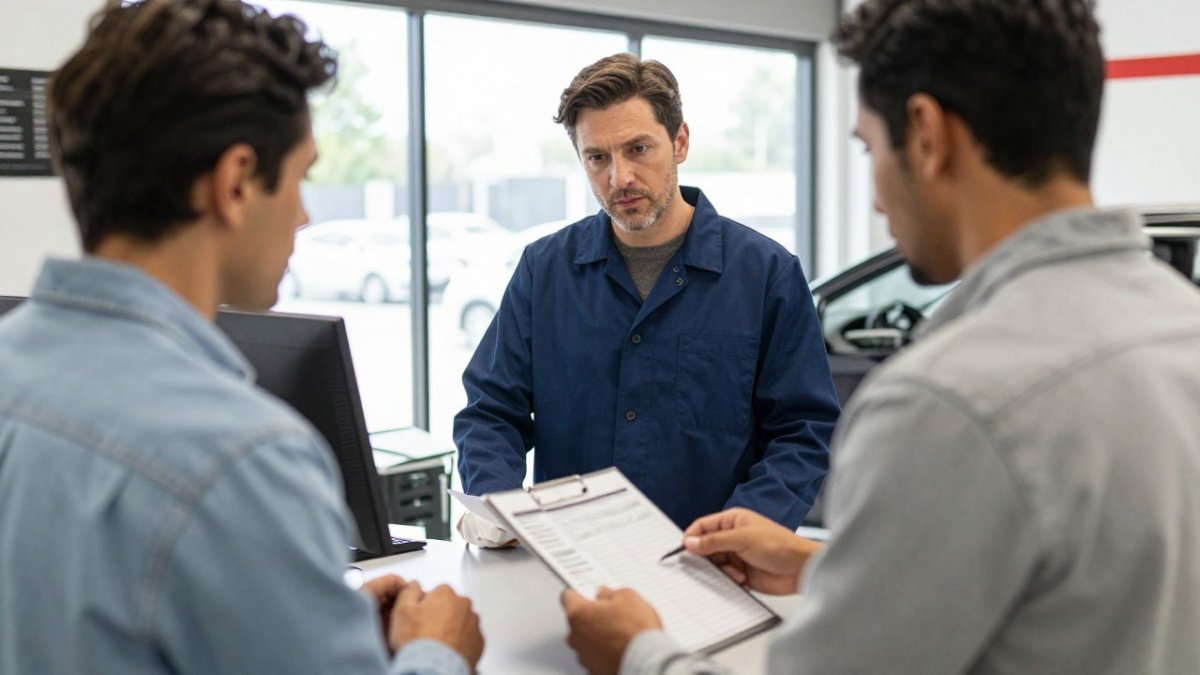
Pricing is where most owners feel the least certainty, and it is also where the widest gap exists between what shops advertise and what you actually pay. The useful comparison is not the lowest number quoted on a phone call. It is the itemized estimate that separates parts, labor hours, diagnostic time, and any shop fees so you can see what each line represents.
How labor rates actually work
A labor rate is an hourly figure, but the total labor charge is the rate multiplied by the book time for the job, not by how long the technician happens to stand at the car.
A higher hourly rate is not automatically the more expensive outcome. The reverse is also true: a lower rate paired with unfamiliarity can turn into a longer job, a second visit, or a part replaced before the real cause is found.
What a diagnostic fee should include
Diagnostic time is the most misunderstood line on an estimate. A diagnostic fee should cover a defined process: reading manufacturer-level fault codes, testing the affected circuit or system, and confirming a root cause before parts are ordered. Ask whether the fee is credited toward the repair if you authorize the work, and ask what happens if the diagnosis is inconclusive. A shop that cannot describe its diagnostic process in advance is asking you to fund guesswork.
Reading an itemized estimate
When you compare estimates, check whether each one includes:
- Diagnostic time, stated separately, and whether it is credited toward the repair if you proceed
- Parts listed by name and part number where available, with OEM, OE-equivalent, or aftermarket clearly identified
- Labor hours for each task, not just a single total
- Any fees for shop supplies, hazardous waste disposal, or environmental charges
- Whether the estimate is a firm quote or an authorization to diagnose up to a stated limit
Watch out: approving a repair over the phone without an itemized estimate makes it hard to question charges later, and it removes your chance to compare the same job across shops.
The parts decision affects the price more than the labor rate
On many luxury-vehicle repairs, parts are the larger share of the bill, and the parts choice is where estimates diverge most. OEM parts carry the manufacturer's name and typically the highest cost. OE-equivalent parts are made to the same specification by a supplier that may also build the OEM part. Aftermarket parts range from reputable brands to low-cost options with shorter service life. Ask each shop which category it plans to use, whether you can choose, and how the choice affects any warranty the shop provides.
A practical comparison method
Pick one maintenance item and one repair you expect to need, and request an itemized estimate for each from two or three shops. Compare the diagnostic fee, the labor hours per task, the parts category and part numbers, the shop-fee lines, and the warranty terms. That side-by-side view tells you more about value than any single hourly rate. For current pricing on a specific repair, contact Euro Specialist directly through its website or request a quote before authorizing work.
The article breaks down what to check on an itemized estimate, so the key items are easy to compare side by side.
| Estimate item | What to check | Why it matters |
|---|---|---|
| Diagnostic fee | Whether it is credited if you proceed | Shows what you pay for defined diagnosis |
| Labor hours | Hours per task, not one total | Hourly rate alone does not set the cost |
| Parts | Name, part number, OEM or aftermarket | Parts often make up the larger share of the bill |
| Shop fees | Supplies, hazardous waste, environmental charges | Extra lines can raise the total |
| Authorization | Firm quote or diagnosis up to a stated limit | Avoids approving work without an itemized estimate |
Parts, Warranty and Service Record Considerations
Parts and warranty coverage affect what you pay over the life of the car, not just on the day of the repair. They also affect two things owners worry about after leaving a dealership: whether independent service could complicate a factory warranty, and whether the service history will hold up at resale. Both concerns are manageable, but only if you understand the mechanisms.
How independent service interacts with a factory warranty
Federal law in the United States generally limits a vehicle manufacturer's ability to void a warranty solely because routine maintenance or repairs were performed by an independent shop (the FTC). Confirm the current rules with the manufacturer or the official source before relying on them.
A common pattern is that warranty disputes arise when there is no record of the maintenance that was supposed to prevent the failure. Keep receipts that show the date, mileage, parts used, and work performed.
OEM, OE-equivalent, and aftermarket parts
Ask whether the shop uses OEM parts, OE-equivalent parts, quality aftermarket parts, or a mix, and whether the choice is yours. OEM parts carry the manufacturer's name and typically the highest cost. OE-equivalent parts are built to the same specification by a supplier that may also produce the OEM part.
For warranty-sensitive repairs, OEM or OE-equivalent parts reduce the chance of a dispute. For older vehicles past the factory warranty, a quality aftermarket part can be a reasonable cost trade-off if the shop stands behind it.
What to ask about the shop's warranty
Euro Specialist states that all of its work is warrantied. Ask for the warranty terms in writing, including:
- How long the coverage lasts, and whether it is stated in months, miles, or both
- Whether it covers parts, labor, or both
- Whether the warranty is honored at the shop only or at a network of locations
- What steps you must take if a problem returns, and any time limit for reporting it
- Whether the warranty is affected if you supply your own parts
Watch out: a verbal assurance that work is "warrantied" is not the same as written terms, and the difference matters if a repair fails months later.
Building a service record that protects resale value
Keep every service record, whether the work was done at a dealer or an independent shop. A complete maintenance history with dates, mileage, and itemized parts and labor is what a future buyer or trade-in appraiser uses to judge how the car was cared for.
A practical habit is to keep a folder, physical or digital, with every estimate, invoice, and warranty document. Note the mileage at each service.
Best Practices for European Car Maintenance Schedules
Following the manufacturer's maintenance schedule is the most reliable way to avoid expensive surprises. European cars often specify intervals for oil, filters, fluids and inspections that differ from what a generic mechanic might suggest.
A practical approach is to pair the schedule with a yearly inspection. Our scheduled maintenance plans put these intervals into a practical service calendar.
Routine services that fit this kind of plan include oil changes, preventative maintenance, brake inspections, battery service and cooling system checks. You can review Euro Specialist's service pages for details.
Booking Your First Visit to Euro Specialist
Your first visit is the best test of any shop. Bring the maintenance records you have, describe the symptoms in detail, and ask the technician to explain the findings before any work begins.
Euro Specialist is a family-owned business focused on honest, dependable service for European vehicles. If you're comparing options for a Porsche, Mercedes-Benz, BMW, Audi or another European make, a short phone call or quote request is a practical next step. Before you commit to the drive, read whether the trip is worth it for luxury car service.
Frequently Asked Questions
Are independent European auto shops cheaper than dealerships?
The total difference between an independent European shop and a dealership depends on the job, the parts used and the vehicle. Ask for an itemized estimate that separates parts, labor and diagnostic fees, then compare those line items against a dealership quote for the same work. Euro Specialist provides current pricing directly, so contact the shop or visit eurospecialistfl.com for a quote tailored to your vehicle.
How do I verify that a mechanic is qualified for my European luxury car?
Ask whether technicians hold current certifications, how long they have worked on your make, and what diagnostic equipment the shop uses for your vehicle. Request to see certification documentation and ask about experience with the specific model and engine. Shops that welcome these questions usually have nothing to hide. Euro Specialist describes its technicians as master-certified and offers a warranty on all work, so ask for the credentials and the warranty terms in writing.
Is it better to use OEM or aftermarket parts for luxury car repairs?
OEM parts match the original specifications for fit and performance, which matters most for sensors, electronics and safety components. Quality aftermarket parts can work well for wear items such as filters, pads and some suspension components, often at a lower cost. Ask the shop which parts it plans to use, why, and whether the warranty covers them. A clear answer to those questions is a good sign.
How often should I service my luxury vehicle to avoid costly repairs?
Follow the maintenance schedule in your owner's manual as the baseline, then adjust for driving conditions such as frequent short trips, heavy heat or stop-and-go traffic. Regular oil changes, brake inspections, cooling system checks and battery testing catch small problems before they become expensive ones. A preventative maintenance visit gives a shop the chance to record the work in a service history that supports resale value and warranty claims.