 ultimate-guide
Porsche Diagnostic Services Near Longwood: 2026 Guide
Table of Contents
- What Porsche Diagnostic Services Near Longwood Actually Involve
- Porsche Check Engine Light Repair: Reading Fault Codes the Right Way
- Common Porsche Electrical System Issues That Trigger Warning Lights
- Independent Porsche Mechanic vs Dealership: What Changes for You
- Pre-Purchase Inspection and Warranty Preservation
- Routine Maintenance Tied to Diagnostics: Oil, Brakes, and Transmission
- What to Ask Before You Book a Diagnostic Appointment
- Frequently Asked Questions
Last Updated: September 23, 2026
What Porsche Diagnostic Services Near Longwood Actually Involve
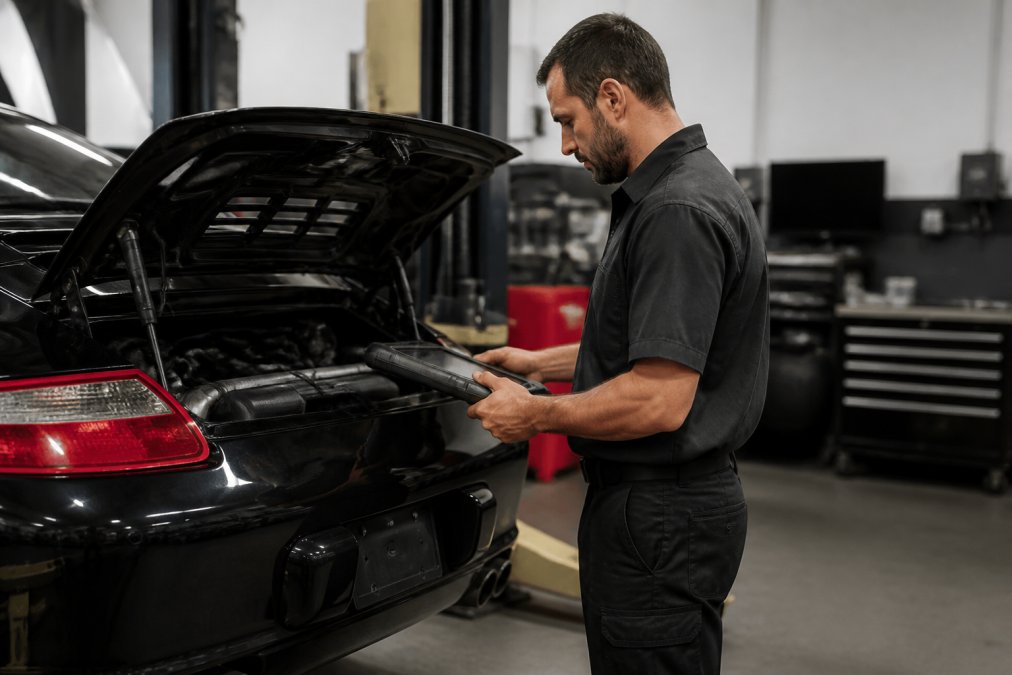
Porsche diagnostic services near Longwood connect factory-approved scan tools to your car's control modules, retrieve fault codes, and interpret live sensor data to pinpoint what is wrong before any part gets replaced. At Euro Specialist, diagnostics is the foundation of every repair.
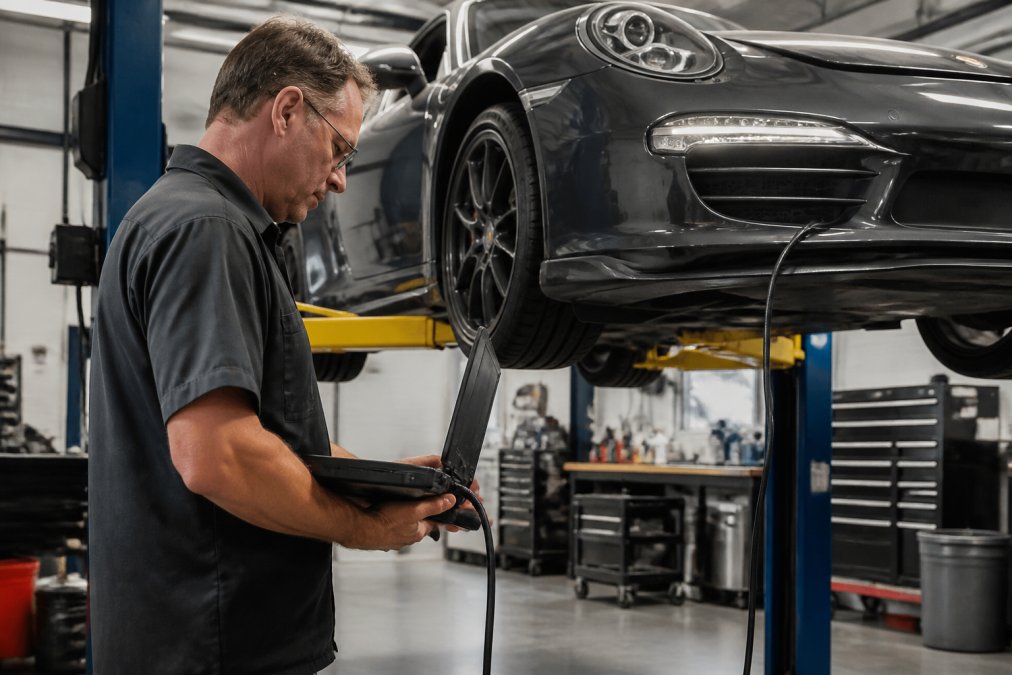
Factory-Approved Tools: PIWIS III and OBD-II Scanning
PIWIS III is Porsche's official diagnostic platform, and it does things a generic OBD-II scanner cannot. A basic scan tool reads emissions-related fault codes from the engine computer; PIWIS III communicates with every module, from the transmission control unit to the air suspension and infotainment system.
The practical difference shows up fast:
- Generic OBD-II scanner: reads powertrain codes, clears the check engine light, tells you almost nothing about cause
- PIWIS III: reads manufacturer-specific diagnostic trouble codes (DTC), runs guided fault-finding routines, performs sensor calibration, and accesses technical service bulletins (TSB) tied to your VIN
Porsche Check Engine Light Repair: Reading Fault Codes the Right Way
Porsche check engine light repair starts with fault code retrieval, but the code itself is rarely the answer. A P0300 code tells you the engine is misfiring somewhere; it does not tell you which cylinder, why, or whether the cause is ignition, fuel delivery, or mechanical.
Good diagnostic work follows a sequence:
- Retrieve all stored and pending codes across every module, not just the engine computer
- Freeze-frame data review to see the exact conditions when the fault triggered (engine temp, load, RPM, speed)
- Live data analysis while the fault is reproduced, watching fuel trims, ignition timing, and sensor voltages in real time
- Hands-on testing of the suspect circuit or component before replacement
- Clear and re-verify to confirm the repair actually resolved the root cause
Common Porsche Electrical System Issues That Trigger Warning Lights
Common Porsche electrical system issues cluster around a handful of failure points, and knowing them helps you describe symptoms accurately when you book service. Electrical diagnostics is where experience separates a fast fix from a parts-swapping marathon.
The failures we see most often:
- Ignition coil degradation on higher-mileage flat-six engines, producing intermittent misfires and rough idle before a hard fault sets
- Battery management and charging faults, which on modern Porsches can cascade into a dozen unrelated warning lights because low voltage confuses multiple modules
- Coolant temperature sensor drift, causing fans to run constantly or the gauge to read incorrectly
- PDK and transmission control faults, often sensor-related rather than mechanical
- Air suspension height sensor failures on Cayenne and Panamera models
Model-Specific Fault Patterns: 911, Cayenne, Macan, and Panamera
Most shops stop at the generic list above. The real value is knowing how the same complaint presents differently across models, because that shapes which module you interrogate first and which live-data channels you watch.
911 (991 and 992 generations)
- Rear-engine placement traps heat around the coil packs and ignition harness, so coil and connector faults show up earlier than on front-engine cars of similar mileage.
- The PDK transmission control unit logs adaptation faults that can mimic engine misfires; a P0300 stored alongside a PDK adaptation code usually means the transmission is feeding the engine bad torque data, not that the engine is failing.
- Dynamic engine mounts and rear-axle steering modules throw chassis warning lights owners often misread as suspension failure.
Cayenne (958 and 9YA generations)
- Air suspension height sensors and the control module are the most common electrical complaint. One failed height sensor can trigger ride-height, stability control, and headlight-leveling warnings at once.
- Transfer case control module faults on earlier 958 models produce drivetrain warnings that look like transmission failure but resolve with a module recalibration.
- Battery drain from the comfort-access and infotainment modules is recurring; parasitic draw testing is often the only way to isolate it.
Macan
- The Macan shares platform architecture with other group vehicles, so some sensors and connectors are common parts, but calibration, coding, and fault thresholds are Porsche-specific. A part that fits is not a part that is coded correctly.
- Coolant pump and thermostat housing faults on earlier Macan S and Turbo models often set codes pointing at the engine management module rather than the cooling circuit.
- Rear hatch and tail light control modules log intermittent faults owners notice as flickering or one-sided lighting.
Panamera
- The most electronically dense of the group. A single low-voltage event, a weak battery, failing alternator, loose ground, can populate fault codes across a dozen modules at once.
- Air suspension and adaptive damping faults are common, and usually trace to a height sensor or wiring harness rather than the strut itself.
- The PDK and hybrid control modules on E-Hybrid models require PIWIS-level access for adaptation and calibration; generic tools cannot complete the procedure.
Why Model-Specific Knowledge Changes the Diagnosis
The same P0300 misfire code on a 911 and a Cayenne sends a technician down two different paths. On the 911, heat-related coil and harness degradation is the first suspect; on the Cayenne, a vacuum leak or fuel delivery issue is more likely. A shop that treats every Porsche the same spends your money on the wrong tests first.
Independent Porsche Mechanic vs Dealership: What Changes for You
The independent Porsche mechanic vs dealership decision comes down to three things: diagnostic tooling, technician specialization, and how the work is priced and warrantied. The gap is much narrower than a decade ago.
Here is what actually differs:
| Factor | Dealership | Well-Equipped Independent Shop |
|---|---|---|
| Diagnostic tools | PIWIS, factory current | PIWIS III or equivalent, may lag on newest models |
| Technician focus | All models in the brand | Often deeper per-model experience |
| Scheduling | Often longer waits | Usually faster, more flexible |
| Communication | Service advisor layer | Direct conversation with the tech |
| Warranty | Factory-backed | Shop-backed, varies by provider |
Pre-Purchase Inspection and Warranty Preservation
A pre-purchase inspection (PPI) is the highest-value diagnostic service for anyone buying a used Porsche, where a thorough chassis inspection and fault code history review can save you from a five-figure mistake. A proper PPI includes a full module scan for stored and historical codes, over-rev data on manual and PDK cars, a suspension geometry check, and fluid analysis where relevant.
Routine Maintenance Tied to Diagnostics: Oil, Brakes, and Transmission
Routine maintenance and diagnostics are not separate services; they feed each other. A preventative maintenance visit is your best early-warning system, because a technician with the car on a lift and a scan tool connected sees problems forming before they become failures.
What a diagnostic-informed service visit covers:
- Oil and fluid services with fluid analysis where useful, catching coolant or oil contamination early
- Brake system inspection and repair, including pad thickness, rotor condition, and brake fluid moisture testing
- Transmission care, including transmission fluid condition checks on PDK units and adaptation resets where appropriate
- Suspension geometry checks, since uneven tire wear often signals alignment or component wear
- Full module scan to catch pending codes that have not yet triggered a dashboard light
How Diagnostic-Led Maintenance Preserves Your Factory Warranty
If your Porsche is still under factory coverage, you do not have to choose between the dealership and an independent shop. What matters is that the work is done correctly, with the right parts, and documented.
In practice, that means three things protect your coverage:
- Correct parts. Where the warranty specifies OEM or OEM-equivalent parts, use them. For wear items like brake pads and filters, a quality equivalent is generally acceptable; for software-dependent components, OEM is the safe choice.
- Correct procedures. Service intervals, fluid specifications, and torque values matter. A diagnostic-led visit documents that the manufacturer's schedule was followed.
- Documentation. Keep every invoice, note the mileage and date, and retain the diagnostic report. If a warranty claim is ever questioned, a clean paper trail is your defense.
What a Diagnostic-Led Service Visit Actually Catches
The value of pairing maintenance with a scan is that some of the most expensive Porsche failures announce themselves quietly first:
- A slowly failing coolant temperature sensor shows up in live data as drift before it ever sets a code.
- PDK adaptation values trending out of range signal clutch wear long before a drivability complaint.
- Brake fluid moisture above the recommended threshold is invisible to the driver but measurable in the bay.
- A pending misfire code on one cylinder, with no dashboard light yet, points to a coil or injector that will fail within a few thousand miles.
What to Ask Before You Book a Diagnostic Appointment
Ask these questions before you hand over your keys to separate a real diagnostic shop from one that guesses.
- What diagnostic platform do you use on Porsches? You want to hear PIWIS or an equivalent factory-level tool.
- Do you charge a diagnostic fee, and does it apply toward the repair? A clear answer here signals honest pricing.
- Will I get the fault codes and findings explained in writing? Transparency in reporting is a good sign.
- Are your technicians certified, and can you show me? Master certification should be verifiable, not just claimed.
- What does your warranty cover? Ask for the specifics in writing before work begins.
- Do you use OEM parts, and will that preserve my warranty? This matters for newer cars still under coverage.
Frequently Asked Questions
What is included in a professional Porsche diagnostic service?
A proper diagnostic visit starts with fault code retrieval using a factory-approved tool like PIWIS III, not a generic OBD-II reader. From there, the technician reviews live sensor data, checks technical service bulletins for known issues, and performs hands-on testing of the affected system. You should receive a vehicle health report explaining what failed, why it failed, and what repair options exist. Ask any shop whether they charge a flat diagnostic fee or bill hourly before you hand over the keys.
Can independent shops perform Porsche diagnostics as well as dealerships?
Yes, when they invest in factory-approved equipment and ongoing training. The difference between an independent Porsche mechanic and a dealership comes down to tool access and pricing structure, not capability. A shop running PIWIS III can read the same diagnostic trouble codes, perform sensor calibration, and access the same service interval data a dealer can. What you lose at some independents is loaner cars and brand-new waiting rooms.
What are the common warning signs that my Porsche needs a diagnostic scan?
A check engine light is the obvious one, but it is not the only signal. Rough idling, delayed shifting, flickering interior electronics, a suspension warning on the dash, or a sudden drop in fuel economy all point to systems that store fault codes. Drivability issues that come and go are especially worth scanning, because intermittent faults leave a history in the ECU even when the car feels fine. Catching these early with a diagnostic scan often prevents a small sensor problem from becoming a larger repair.
Do I need specialized equipment for Porsche engine diagnostics?
For basic fault code retrieval, a generic OBD-II scanner works on any car built after 1996. For Porsche-specific work, you need a tool that reads manufacturer-level data: PIWIS III is the factory-approved platform, and it handles engine management, transmission, chassis, and electrical modules that generic scanners cannot reach. Sensor calibration, transmission fluid adaptation resets, and performance tuning parameters all require this level of access. Ask any shop which diagnostic platform they use before booking.
Finding a shop that reads Porsche fault codes correctly, explains what they mean, and stands behind the repair is harder than it should be. Euro Specialist is family-owned, staffed by master-certified technicians with expertise across all European makes, and every job we do is backed by a warranty on our work. If you want honest diagnostics and a straight answer about what your car actually needs, schedule an appointment with Euro Specialist and get a clear picture of your Porsche's health.