 blog
Best Synthetic Oil for High-Mileage European Engines
Last Updated: November 24, 2026
Quick Summary
The best synthetic oil for high-mileage European engines is one that carries the exact OEM approval your engine calls for, such as VW 504 00/507 00, BMW Longlife-04, or Mercedes-Benz 229.51, in the viscosity your climate and oil-consumption pattern require. Check your owner's manual first, because the approval code overrides any brand ranking.
- A European motor oil approval is the automaker's own certification, not the same as an API rating.
- Turbocharged direct-injection four-cylinders often specify a low-SAPS oil to protect emissions hardware.
- Low-SAPS oil is non-negotiable for diesels with particulate filters, such as VW 507 00.
- Keep the manufacturer's specified SAE grade unless oil analysis or a qualified technician shows a reason to change.
- Short trips, stop-and-go commuting, and cold starts qualify as severe service and call for a shorter drain interval.
Table of Contents
- What is the best synthetic oil for high-mileage European engines?
- How European Motor Oil Approvals Decide the Right Brand
- Ranking Synthetic Oil Brands by Approval and Engine Fit
- Oil Viscosity for High-Mileage European Engines: What to Choose
- Why High-Mileage Oil for European Cars Is Not a Universal Fix
- Oil Consumption in Older European Cars: Causes and What Oil Can Do
- Used-Oil Analysis: The Test That Settles Brand Debates
- Schedule an Oil Change With a Shop That Reads Your Approval Code
- Frequently Asked Questions
What is the best synthetic oil for high-mileage European engines?
The best synthetic oil for high-mileage European engines is one that carries the exact manufacturer approval your engine calls for, not simply the thickest or most expensive bottle on the shelf.
Here is what most brand rankings skip: high-mileage European engines are not a single category. A turbocharged direct-injection four-cylinder and a naturally aspirated inline-six have different needs, approval codes, and tolerances for seal conditioners and thicker base stocks. Picking a brand before picking an approval is backwards.
Below, we break down how European motor oil approvals work, rank the major synthetic brands by approval coverage and engine fit, and show you how to verify a bottle actually protects your engine.
How European Motor Oil Approvals Decide the Right Brand
A European motor oil approval is the automaker's own certification that a specific oil meets its engine-protection, emissions, and drain-interval requirements. It is not the same as an API rating, and it is not interchangeable with one.
Most buyers read "full synthetic" on the front label and assume that settles it. It doesn't. Volkswagen, BMW, Mercedes-Benz, and Porsche each publish their own approval lists, and an oil only earns those numbers after passing the automaker's tests.
Three specifications matter most:
- OEM approvals like VW 504 00/507 00, BMW Longlife-04, or Mercedes-Benz 229.51, which tie directly to your engine and emissions hardware
- ACEA specifications, the European industry standard that grades oils by engine type and performance
- API service categories, the American baseline that many European engines exceed
Check your owner's manual first. The approval code printed there is the only number that matters, and it overrides any brand ranking, including ours.
Ranking Synthetic Oil Brands by Approval and Engine Fit
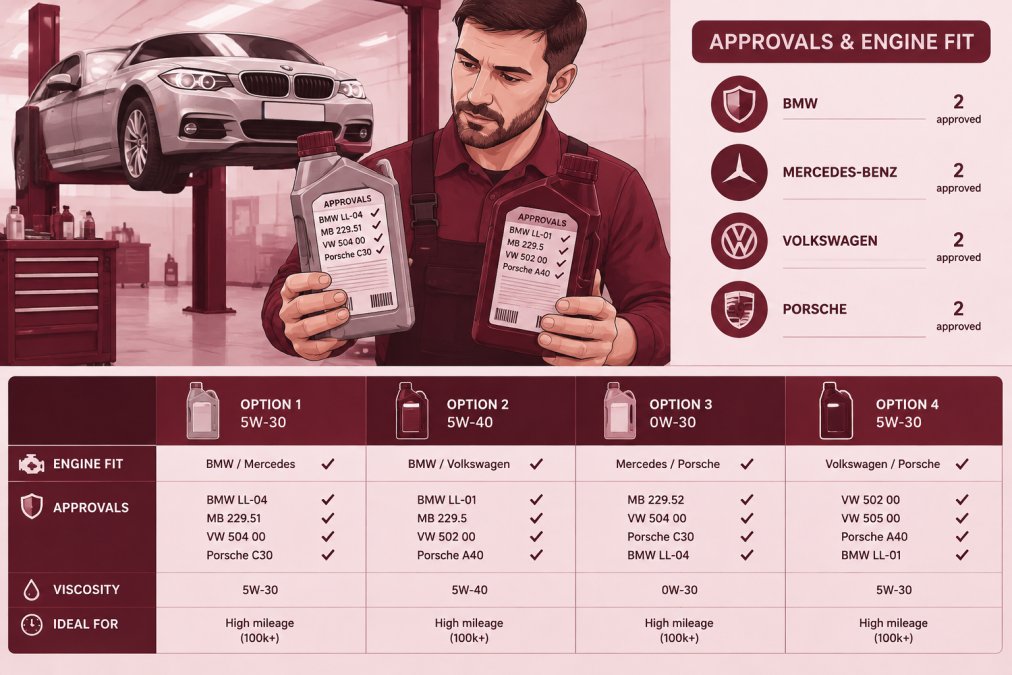
Use the approval code in your owner's manual as the deciding factor when comparing bottles, and verify the exact approval printed on the label you are holding.
| Brand | Strength | Best For | Watch Out For |
|---|---|---|---|
| Mobil 1 | Broad European approval coverage | Mixed fleets, many makes | Verify the exact approval per bottle |
| Castrol Edge | Turbo and direct-injection protection | VW, Audi, BMW turbo engines | Some variants are region-specific |
| Valvoline | Value high-mileage additive packages | Budget-conscious owners | Confirm OEM approval on the label |
| Pennzoil / Shell | Emissions-system compatibility | Low-SAPS diesel and GPF cars | Not every grade carries the approval |
| Amsoil | Extended-drain claims | High annual mileage | Verify approval, not just marketing |
How to Read This Shortlist by Engine and Approval
The useful question is which bottle carries the approval your engine was built around, in the viscosity your climate and consumption pattern call for.
A full synthetic with the specified approval and a climate-matched viscosity is the right call. Confirm the OEM approval before buying on price.
Diesel engines with diesel particulate filters (BMW, Mercedes-Benz, Volkswagen TDI). Low-SAPS is non-negotiable here. The wrong oil can shorten DPF life and trigger costly emissions repairs.
Performance and older turbo engines (Porsche, BMW M, Audi S/RS). Do not assume a brand's flagship oil carries the approval your engine needs.
What the Brands Actually Do Well, and Where They Fall Short
Mobil 1: Broad European approval coverage. The catch: Mobil 1 is a family of oils, not one oil.
Castrol Edge: Strong for turbocharged and direct-injection engines. Where it falls short is clarity: Castrol sells many Edge variants, and only some carry the approval your car requires.
Valvoline: Value options with high-mileage additive packages. Confirm the OEM approval is present before you buy on price alone.
Amsoil: Extended-drain claims and verification. Extended drains only make sense if the oil genuinely carries the approval and your driving qualifies as normal service rather than severe service.
A Note on High-Mileage Labels and European Approvals
A "high-mileage" label on a bottle is a marketing category, not an approval. Some high-mileage oils carry the European approval your engine needs; many do not. Before you pay a premium, check the back label for the OEM approval code. If it is missing, the oil is not the right choice for your European engine, regardless of what the front of the bottle promises. The same logic applies to extended-drain claims: an approval code is evidence, a marketing claim is not.
Oil Viscosity for High-Mileage European Engines: What to Choose
Oil viscosity for high-mileage European engines should stay at the manufacturer's specified SAE grade unless an oil analysis or a qualified technician shows a reason to change it. Thicker is not automatically safer.
Older engines develop wider clearances, and some owners jump to a heavier grade hoping to slow consumption. Sometimes that helps. Often it just increases pumping losses and cold-start wear. Keep the specified grade, confirm the approval, and let used-oil analysis tell you whether a change is warranted.
Match Viscosity to Climate, Not Just Mileage
The grade on the oil cap assumes a moderate climate. Where winter mornings drop well below freezing, a 5W or 0W grade flows faster at cold start and reduces the dry-start wear that ages an engine. Where summer heat is extreme and you tow or drive mountain grades, the high-temperature side of the grade matters more. The owner's manual often lists a viscosity chart by ambient temperature; use it. For a high-mileage engine, cold-start protection is where most wear happens, so do not default to the thickest grade in the chart.
Driving Pattern Changes the Interval More Than the Brand
The single biggest variable in oil life is not the brand on the bottle. It is how you drive. Short trips that never bring the oil to full temperature leave moisture and fuel in the crankcase, which thins the oil and accelerates wear. Stop-and-go commuting, frequent cold starts, towing, and dusty conditions all qualify as severe service under most European maintenance schedules, and severe service calls for a shorter drain interval than the manual's normal-service number. Long-distance highway driving at steady speed is the easiest life an oil can have.
Use Oil Analysis to Decide, Not Guess
Used-oil analysis turns this from opinion into data. A laboratory report shows wear metals, fuel dilution, coolant contamination, and whether the oil stayed in grade. Run two or three analyses across intervals and you will see whether your oil is thinning, whether fuel is diluting it, and whether your driving pattern supports the interval you are using.
Watch out: do not switch to a thicker grade to mask consumption without diagnosing the cause first. A thicker oil can slow a seep, but it can also hide a failing PCV system or worn rings until the problem gets more expensive.
A Practical Decision Path
Start with the approval code in the owner's manual. Confirm the viscosity chart for your climate. Classify your driving as normal or severe service. If severe, shorten the interval. If consumption is rising or you are considering a viscosity change, run an oil analysis first. That sequence keeps you inside the manufacturer's specification while accounting for how you actually drive.
Why High-Mileage Oil for European Cars Is Not a Universal Fix
High-mileage oil for European cars is a formulation choice, not a cure. It adds seal conditioners and sometimes a thicker base stock, which can reduce minor seepage. It cannot rebuild worn bearings, restore compression, or undo sludge.
We see owners spend on premium high-mileage oil while ignoring the real cause: a failing PCV system, a leaking valve cover gasket, or worn rings. If you are weighing whether the treatment is worth it, our breakdown of whether high mileage service is worth the cost covers the trade-offs honestly. High-mileage oil is a tool, not a fix.
Oil Consumption in Older European Cars: Causes and What Oil Can Do
Oil consumption in older European cars usually traces to worn valve guides, tired piston rings, a clogged PCV system, or leaking seals. Oil choice can slow the symptoms but cannot reverse mechanical wear.
Here is the honest split. If your engine burns oil because a seal is seeping, a seal-conditioning oil may help. If it burns oil because rings or guides are worn, no bottle fixes that. For engines that need deeper attention, our guide to maintaining a performance vehicle engine walks through the habits that extend life, and if consumption points to worn internals, our engine repair service is the next step.
Used-Oil Analysis: The Test That Settles Brand Debates
Used-oil analysis is a lab test of your drained oil that measures wear metals, fuel dilution, coolant, and viscosity.
Instead of arguing about brands online, send a sample at your next change. The report shows iron, aluminum, and copper levels, whether your oil thinned out, and whether fuel is diluting it. Run two or three analyses across intervals and you have real data on your engine, not someone else's opinion.
Schedule an Oil Change With a Shop That Reads Your Approval Code
The right oil only works when it is the correct approval, the correct viscosity, and changed on the right interval for how you actually drive.
At Euro Specialist, our master-certified technicians match the oil to your engine and emissions hardware, and all our work is warrantied. We handle routine scheduled maintenance and factory maintenance that follows your manufacturer's schedule, so your high-mileage European engine gets exactly what it was built for.
If your European car is burning oil, due for a change, or you simply want the right oil confirmed by someone who reads approval codes for a living, we can help.
Frequently Asked Questions
Can I use high-mileage oil in a European car?
Yes, but only if the oil still carries the manufacturer approval listed in your owner's manual. High-mileage formulas add seal conditioners and a thicker additive package, which can help older engines with minor seepage. The problem is that some high-mileage oils drop the ACEA or OEM approval your engine was built around. Check the back label for the exact approval code before you buy. If the approval is missing, the seal benefit is not worth the trade-off.
Should I choose oil by brand or by the vehicle manufacturer's approval?
Choose by approval first, brand second. Every European automaker publishes an approval list, and an oil either holds that approval or it does not. Brand reputation tells you who has the engineering resources to earn approvals across many specifications. It does not tell you whether a specific bottle meets your engine's requirement. Read the approval code on the container, confirm it matches your owner's manual, and only then compare brands on price and availability.
Does high-mileage synthetic oil help reduce leaks or oil consumption?
It can slow minor seeping by conditioning hardened seals, but it will not fix worn piston rings, a failing valve cover gasket, or a bad PCV system. If you are adding a quart every 1,000 miles, an oil change alone will not solve it. A used-oil analysis and a shop inspection will tell you whether the loss is internal wear or an external leak. Treat high-mileage oil as maintenance, not a repair.
How do I find the correct oil specification for my European car?
Start with the owner's manual, which lists the required viscosity and the OEM approval code. Cross-check that code against the oil container's label, not the marketing name on the front. Diesel engines with a particulate filter usually need a low-SAPS oil. If the manual is missing, ask a shop that works on European makes for help identifying the specification.