 how-to
7 Signs Your Luxury Car Needs Diagnostic Testing
Quick Summary
Signs your luxury car needs diagnostic attention include a check engine light that stays on or flashes, warning messages on the dashboard, new noises or vibrations, rough idling, hesitation while accelerating, and lower fuel economy over several weeks. A flashing light signals an active misfire and calls for stopping the car right away.
- A steady check engine light means a fault is logged and should be checked soon.
- A flashing check engine light signals an active misfire; reduce speed and get the car inspected right away.
- Red warnings for oil pressure, coolant temperature, brakes, steering or high voltage mean stop driving.
- Do not clear codes before testing, because clearing erases freeze-frame data the technician needs.
- A fault code is not a diagnosis; it shows where a problem was detected, not what caused it.
Table of Contents
- Why Luxury Cars Need Diagnostics Sooner Than You Think
- Check Engine Light Diagnosis: What a Lit Dashboard Is Telling You
- European Car Warning Lights and Messages You Should Never Ignore
- Noises, Vibrations, and Performance Changes That Point to a Fault
- Intermittent Symptoms: How to Document Them Before Your Visit
- The Car Diagnostic Process: What a Proper Test Sequence Looks Like
- Step 1: Interview and history review
- Step 2: Verify the complaint
- Step 3: Scan all modules, not just the engine
- Step 4: Read live data and freeze-frame data
- Step 5: Perform bidirectional and functional tests
- Step 6: Visual and mechanical inspection
- Step 7: Confirmatory measurement
- Step 8: Repair and verification
- Diagnostic fees and what affects them
- Diagnosis versus repair estimate
- How to tell a thorough test from a quick scan
- Car Diagnostic Scanner Limitations and Why a Code Is Not a Diagnosis
- Booking Your Luxury Car Diagnostic at Euro Specialist
- Frequently Asked Questions
Why Luxury Cars Need Diagnostics Sooner Than You Think
Last Updated: November 2, 2026
Luxury cars carry more sensors, control modules and software than most drivers realize, so learning the signs your luxury car needs diagnostic attention early can keep a small problem from becoming an expensive one.
Most warning signs are subtle: a slight hesitation, an odd smell, or a light that flickers once and disappears.
Here's what most owners miss: a fault code is not a diagnosis. A code tells you where the system detected a problem, not what caused it.
Check Engine Light Diagnosis: What a Lit Dashboard Is Telling You
The check engine light is the most common reason owners book a diagnostic test. It means the engine control system has logged a fault, minor, like a loose fuel cap, or serious, like a misfire that can damage the catalytic converter.
- A steady light usually means a fault has been detected and should be checked soon.
- A flashing light often signals an active misfire. Reduce speed and get the car inspected right away.
- A light that comes on and goes off may point to an intermittent fault that needs documentation.
A common mistake is clearing the code and driving on. The light may go off, but the underlying fault remains.
European Car Warning Lights and Messages You Should Never Ignore
European luxury vehicles route dozens of systems through the same dashboard, and symbols are not standardized across brands. A message that means "service soon" on one model can mean "stop now" on another. Below are the warnings most likely to appear and how urgently to act.
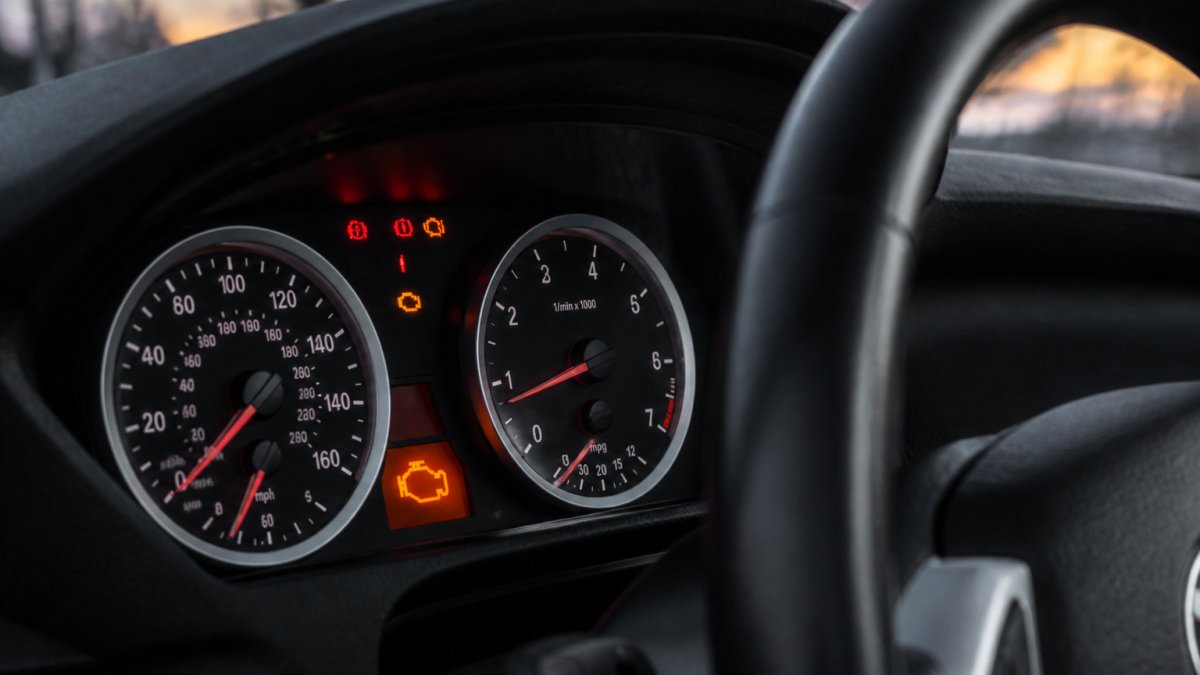
Stop safely and shut down:
- Oil pressure warning (red oil can): Oil is not circulating at adequate pressure. Continuing to drive can destroy bearings and the turbocharger within minutes. Pull over, shut off the engine, and check the oil level only after the engine cools.
- Coolant temperature warning (red thermometer): Overheating can warp aluminum cylinder heads. Stop, let the engine cool, and do not open the coolant reservoir while hot.
- Brake system warning (red circle with exclamation): Could indicate low fluid, a hydraulic fault, or an electronic parking brake fault. Do not continue at highway speed.
Book a diagnostic soon (amber/yellow):
- Check engine / engine management: A steady light means a fault is logged. A flashing light means an active misfire that can damage the catalytic converter, treat a flashing light as a stop-driving condition.
- Air suspension fault (often a car icon with up/down arrows): The vehicle may drop to a bump stop or ride at a fixed height. Driving on a failed air strut can damage the compressor and adjacent components.
- Adaptive damping / chassis fault: The car may default to a stiff fixed damping mode. Handling changes, so reduce speed and book a test.
What to do in the first 10 minutes
- Note the exact message and symbol. Photograph the dashboard; some messages clear when the ignition cycles and will not reappear for the technician.
- Decide stop vs. continue. Red warnings for oil pressure, coolant temperature, brakes, steering, or high voltage mean stop. Amber warnings generally allow a cautious drive to a shop, but avoid heavy loads and high speeds.
- Record conditions. Outside temperature, speed, load, and whether the message appeared on startup, during acceleration, or after a bump all narrow the cause.
- Do not clear codes. Clearing a code erases freeze-frame data the technician needs.
- Call ahead. Tell the shop what message appeared so they can prepare the right scan tool and, if needed, arrange a tow.
What to do before the appointment
- Check the owner's manual for the specific symbol; luxury brands often publish a symbol glossary.
- Check fluid levels only when the engine is cold and the car is on level ground.
- Avoid aftermarket additives or "reset" procedures that can mask the fault.
A warning light is a request for information, not a verdict. The diagnostic test tells you which module logged the fault and under what conditions, the difference between a targeted repair and a guess.
Noises, Vibrations, and Performance Changes That Point to a Fault
Your car talks to you through sound and feel. A new noise, vibration or change in performance is often the first sign of a developing problem.
- Knocking or ticking from the engine can signal low oil or internal wear.
- Whining or squealing may point to a belt, pulley or pump.
- Exhaust noise or smoke can indicate emissions or combustion faults.
Note when each symptom happens. Cold starts, highway speeds and hard braking all narrow down the cause, helping the technician focus the test.
Intermittent Symptoms: How to Document Them Before Your Visit
Intermittent faults are the hardest to diagnose because the technician may never see them happen in the shop. Good notes make a big difference.
Before you book, write down:
- What you noticed and when it started
- How often it happens and how long it lasts
- The conditions, such as cold weather, rain, heavy load or highway driving
If possible, record a short video of the noise or warning message. Clear documentation helps the technician reproduce the problem and avoid guessing.
The Car Diagnostic Process: What a Proper Test Sequence Looks Like
A diagnostic test on a luxury vehicle is more than a single scan.
Step 1: Interview and history review
The technician starts with your notes: when the symptom began, what conditions trigger it, and what repairs or modifications came before. Service records matter because a recent battery replacement, software update, or aftermarket part can set faults that look unrelated.
Step 2: Verify the complaint
The symptom is reproduced, if possible, under the same conditions you described. A fault that cannot be reproduced is documented, not dismissed, intermittent faults are common on luxury vehicles and require a different testing strategy.
Step 3: Scan all modules, not just the engine
A luxury car may have many control modules, and a fault in one can set codes elsewhere.
Step 4: Read live data and freeze-frame data
Freeze-frame data records the conditions at the moment the fault set: engine speed, load, temperature, vehicle speed, and sensor voltages. Live data shows what sensors report right now. Comparing the two tells the technician whether a sensor is reading plausibly or is biased, stuck, or intermittent.
Step 5: Perform bidirectional and functional tests
Modern scan tools can command components on and off, fuel injectors, cooling fans, suspension compressors, EGR valves, and more. Commanding a component and watching the system respond confirms whether the part works and whether the wiring and module can control it. This step isolates many luxury-specific faults.
Step 6: Visual and mechanical inspection
Wiring harnesses, connectors, ground straps, vacuum lines, and mounts are checked for corrosion, chafing, and leaks. Luxury vehicles often hide modules and harnesses behind trim panels, so this step takes longer than on a mainstream car.
Step 7: Confirmatory measurement
Voltage drops, pressure tests, smoke tests, and oscilloscope traces confirm or rule out the suspected cause. A code pointing to an oxygen sensor, for example, may actually be caused by an intake leak, a wiring fault, or a failing catalytic converter. The confirmatory test separates a diagnosis from a guess.
Step 8: Repair and verification
After the repair, the technician clears codes, performs any required relearn or adaptation procedures (common after battery, throttle body, or suspension work), and test-drives the vehicle to confirm the fault does not return.
Diagnostic fees and what affects them
Diagnostic fees depend on the vehicle and the complexity of the fault. Factors that can affect the cost include:
- Faults in multiple modules or intermittent faults that require extended test drives
- Vehicles that require manufacturer-specific software subscriptions or special tools
- Access time for modules buried behind interior trim
Ask what the diagnostic fee covers before booking, and contact Euro Specialist for current pricing.
Diagnosis versus repair estimate
A diagnosis identifies the cause. A repair estimate prices the fix. They are different documents.
How to tell a thorough test from a quick scan
If your luxury car is showing symptoms, the goal is to find the cause rather than collect codes.
A proper diagnostic test follows a sequence of steps, each building on the last, so the cause is confirmed rather than guessed.
| Step | What the technician does | Key detail |
|---|---|---|
| 1. Interview and history | Reviews your notes and service records | Recent battery, software or aftermarket work matters |
| 2. Verify the complaint | Reproduces the symptom under the same conditions | Unreproducible faults are documented, not dismissed |
| 3. Scan all modules | Reads codes from every control module | A fault in one module can set codes elsewhere |
| 4. Live and freeze-frame data | Compares recorded conditions with current sensor readings | Shows whether a sensor reads plausibly |
| 5. Bidirectional tests | Commands components on and off | Confirms whether the part and its wiring work |
| 6. Visual inspection | Checks harnesses, connectors, grounds and vacuum lines | Hidden modules make this step take longer |
| 7. Confirmatory measurement | Voltage drop, pressure, smoke or scope tests | Separates a diagnosis from a guess |
| 8. Repair and verification | Clears codes, runs relearns, test-drives the car | Confirms the fault does not return |
Car Diagnostic Scanner Limitations and Why a Code Is Not a Diagnosis
Affordable handheld scanners can read fault codes, which is useful. However, a scanner shows only what the car's computer has logged. It does not explain why the fault happened.
Common limitations include:
- A code may point to a sensor, but the real cause could be wiring, a connector or a vacuum leak.
- Some faults set codes only under specific conditions that a scanner cannot recreate.
- Clearing codes without a repair can hide the problem and make later diagnosis harder.
Use a scanner as a starting point. The code tells you where to look. A proper test confirms what is actually wrong.
Booking Your Luxury Car Diagnostic at Euro Specialist
If one or more of these signs sound familiar, it may be time for a professional test. Our master-certified technicians work across all European makes, and all of our work is warrantied.
For routine checks and preventive work, you can also review our preventative maintenance services, and if a fault is confirmed, our engine repair services cover the next step.
Frequently Asked Questions
What are the signs that a luxury car needs a diagnostic test?
Common signs include a lit check engine light, warning messages on the instrument cluster, rough idling, hesitation or jerking under acceleration, unusual noises, a drop in fuel economy, difficulty starting, and electrical faults such as flickering lights or infotainment failures. Intermittent problems count too, especially when they appear only in certain conditions. Because these symptoms can have many causes, a professional test sequence is more reliable than guessing from the symptom alone. If a warning is flashing, or the car is losing power or overheating, stop driving and arrange service promptly.
Can a check engine light come on without a serious problem?
Yes. A check engine light can be triggered by a loose or faulty gas cap, a sensor operating slightly out of range, or a minor emissions issue. It can also signal something more serious, such as a misfire or a fault that can damage the catalytic converter if ignored. A steady light calls for a diagnostic check soon, while a flashing light indicates an active misfire and calls for prompt attention. Only a proper diagnostic test can tell the two apart with confidence.
Can an OBD-II scanner diagnose every problem in a luxury car?
No. A basic OBD-II scanner reads fault codes stored by the engine or emissions systems, but European luxury cars use many interconnected modules for suspension, electronics, transmission, and driver assistance that generic scanners often cannot fully access. A code tells you where the system detected a problem, not what component failed or why. Professional diagnostic equipment, technician experience, and live-data analysis are needed to confirm the root cause before repairs begin.
What does a luxury car diagnostic test involve?
A diagnostic test typically begins with a review of your description of the symptoms and any warning messages. Pricing depends on the vehicle, the complexity of the fault, and the time required, so request a quote from Euro Specialist for current pricing before booking.