 How-to
How to Verify Technician Credentials for Luxury Vehicle Service
Last Updated: November 15, 2026
Quick Summary
To verify technician credentials, ask for the technician's full legal name and certification number, then confirm active status and scope in the issuing organization's official database. For luxury vehicles, also request the manufacturer-specific training record and confirm it through the brand's own channel.
- An ASE lookup by name takes about two minutes and needs only the technician's full legal name.
- Check the scope field, since a technician may be certified in brakes and nothing else.
- Confirm the status reads active and the expiration date is in the future, not past.
- A verbal claim of factory-trained is not verification; ask for a course name, completion date, and record.
- Do not accept a photograph of a certificate; use the issuer's database and shop training records.
Table of Contents
- Why Technician Credentials Matter for Luxury Vehicle Service
- How to Check If a Mechanic Is ASE Certified
- ASE Certification Lookup by Name: A Practical Walkthrough
- The ASE Certifications List: Which Credentials Apply to Your Vehicle
- Manufacturer-Specific Automotive Technician Training: The Luxury Make Difference
- Questions to Ask a Service Advisor Before Booking
- Credential Verification Versus Shop Capability: What Certificates Do Not Tell You
- Schedule Service with Master-Certified European Specialists
- Frequently Asked Questions
Why Technician Credentials Matter for Luxury Vehicle Service
A luxury vehicle is an expensive, complex machine, and the person working on it should be able to prove their training. Verifying technician credentials means confirming, at the source, that the person touching your car holds current, relevant certifications for your specific make.
Anyone can print a certificate. What matters is whether that credential is active, whether it covers your vehicle's make, and whether the issuing organization confirms it.
What Technician Certifications Actually Mean
A technician certification is a credential issued by a recognized body or manufacturer confirming that a technician passed specific training and testing. It is not a license to repair cars.
Two broad types exist:
- Industry certification, such as ASE, which tests general automotive knowledge across systems
- Manufacturer or factory training, which covers one brand's specific models, tools, and software
For a luxury vehicle, factory training carries real weight. A general certification says the technician knows how cars work. Factory training says they know how your car works.
How to Check If a Mechanic Is ASE Certified
The fastest path is ASE's own online lookup. ASE, the National Institute for Automotive Service Excellence, maintains a public database you can search yourself.
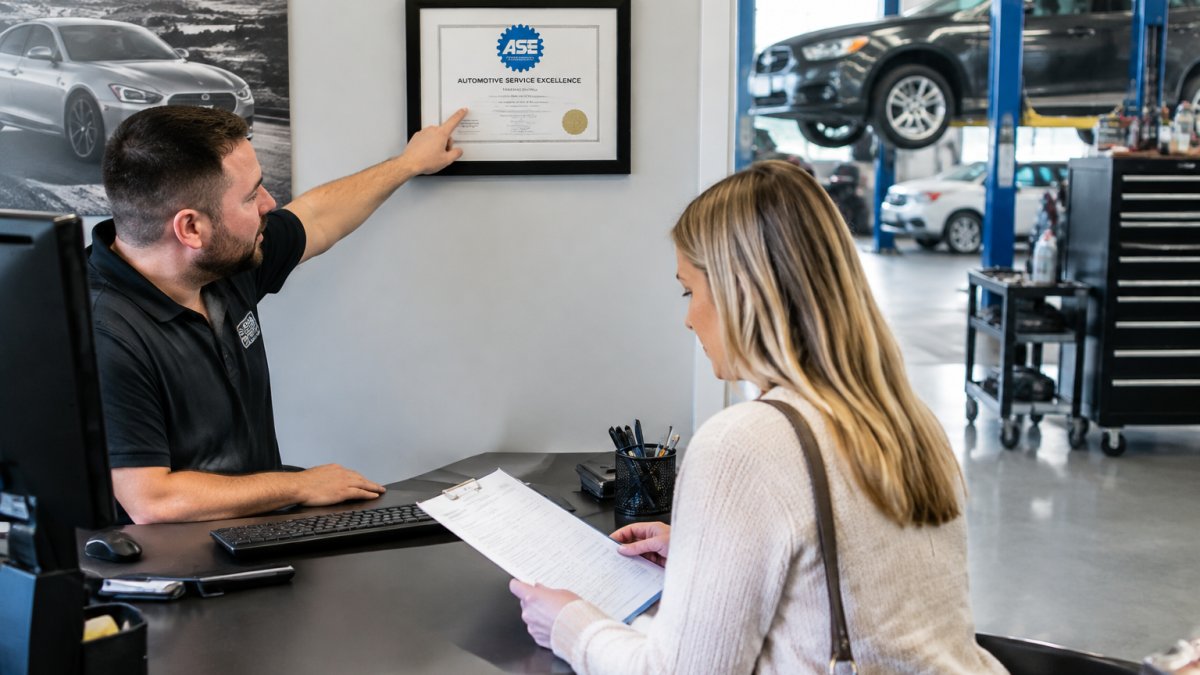
Step-by-Step ASE Verification
Follow these steps in order:
- Ask for the technician's full name as it appears on their certification.
- Request the certification number. Every ASE-certified technician has one.
- Open the ASE certification lookup tool official database.
- Search by name or certification number.
- Confirm the status reads active, not expired.
- Check which areas are certified, such as brakes, engine repair, or electrical.
- Note the expiration date and confirm it is in the future.
If a shop hesitates to give you a name and number, that is your answer. Legitimate shops share this freely. For a deeper walkthrough, see our guide on how to verify a master certified mechanic.
ASE Certification Lookup by Name: A Practical Walkthrough
An ASE certification lookup by name takes about two minutes and requires nothing from the shop except the technician's name. Type the name into the ASE database and confirm the record matches the person in front of you.
A common mistake is searching a nickname. Certifications are filed under legal names, so ask for the full name on the certificate. If two technicians share a name, the certification number settles it.
What most guides miss is the scope field. A technician can be ASE certified in brakes and nothing else. That is a real credential, but it does not qualify them to diagnose a complex electrical fault.
The ASE Certifications List: Which Credentials Apply to Your Vehicle
ASE offers certifications across many systems, and the right ones depend on the job. Here is how the main categories map to common work:
| Certification Area | What It Covers | When It Matters |
|---|---|---|
| Brakes | Pads, rotors, hydraulic systems | Brake inspections and repair |
| Engine Repair | Internal engine components | Engine diagnostics and rebuilds |
| Electrical/Electronic | Wiring, modules, sensors | Electrical fault tracing |
| Heating and A/C | Climate control systems | A/C service and repair |
| Suspension and Steering | Ride and handling components | Alignment and suspension work |
A master certification means the technician has passed a core group of these areas. That is a stronger signal than a single specialty, but it still does not cover make-specific systems.
Separating Active Certification from Expired Certification
An active certification is current and renewed; an expired certification lapsed and no longer counts. ASE credentials require periodic renewal, so a technician certified years ago may no longer hold valid status.
Always check the status field, not just the presence of a record. A database entry with a past expiration date tells you the technician once qualified, not that they do now.
Manufacturer-Specific Automotive Technician Training: The Luxury Make Difference
Factory training is where luxury service separates itself. A BMW, Mercedes-Benz, Audi, or Porsche carries proprietary diagnostic software, specialized tools, and systems a general certification never touches.
Official ASE certification information confirms general competence. It does not confirm that a technician has ever connected a factory scan tool to your model. Those are different questions.
Why General Certification Is Not Enough for a Luxury Marque
ASE tests general automotive knowledge, not whether a technician knows the relearn procedure for a specific adaptive suspension or the high-voltage safety steps for one brand's plug-in hybrid. Each luxury maker runs its own training path, tracked by the manufacturer, not by ASE. That is why a technician can be master-certified and still be unfamiliar with your vehicle's diagnostic architecture.
How to Verify Make-Specific Training, Marque by Marque
The verification method is similar across luxury brands, but the issuer and the evidence differ. Ask which manufacturer training path the assigned technician has completed, then confirm it through that brand's channel.
- BMW: Ask whether the technician has completed the brand's diagnostic and systems courses for your model family, and request the training record or completion confirmation the shop maintains.
- Mercedes-Benz: Ask for the specific course level completed and whether it covers the systems on your vehicle, such as chassis, drivetrain, or high-voltage.
- Audi: Confirm the technician has completed courses tied to your platform, not just an introductory brand overview.
What to Ask for and What It Proves
Request three things: the technician's name, the specific manufacturer training completed, and the date or level of that training. Then ask the shop to confirm it through the manufacturer's own channel or its internal training records. A verbal claim of "factory-trained" is not verification. A course name, a completion date, and a record the shop can produce is.
Our article on why European cars need specialized tools explains the equipment gap in detail. The short version: the wrong tools and software lead to guesswork, and guesswork leads to bills.
Questions to Ask a Service Advisor Before Booking
Ask these directly, and listen for specifics rather than assurances:
- Which certifications do your technicians hold, and are they current?
- Do you have factory-trained technicians for my make?
- Can I see the certification number for the person working on my car?
Push on the last two. A shop that explains its warranty in plain terms is telling you something. So is one that gets vague. Our guide on how to find an honest European car mechanic covers the vetting process in more depth.
Credential Verification Versus Shop Capability: What Certificates Do Not Tell You
A certificate proves training. It does not prove the shop can fix your car. This is the gap that trips up careful buyers.
The Verification Script: Exact Questions and What Each Answer Proves
Ask these in order and write down the answers. Each question is designed to produce a checkable fact, not an assurance.
- "What is the full legal name of the technician who will work on my car?", Gives you the name to search in the issuer's database.
- "What is that technician's certification number, and which organization issued it?", Lets you verify status and scope at the source.
- "Which manufacturer training has that technician completed for my make, and when?", Separates brand-specific training from general certification.
- "Can you show me the training record or completion confirmation for that technician?", Tests whether the claim is documented or verbal.
- "What diagnostic equipment and software access does your shop have for my model?", Connects training to the tools required to use it.
- "What is your warranty, in plain terms, and who backs it?", Reveals whether the shop stands behind the work.
- "Will you call me before any work beyond the estimate?", Confirms the authorization process.
A shop that answers these with specifics is giving you verifiable information. A shop that answers with assurances alone leaves you without verifiable information.
The Document Checklist
Request and review these items before booking:
- The technician's certification number and issuing organization, so you can run an independent lookup.
- The manufacturer training record or completion confirmation for the assigned technician.
- The shop's written warranty terms, including what is covered and for how long.
Do not accept a photograph of a certificate as verification. A photo can be old, edited, or belong to someone else. The issuer's database and the shop's training records are the sources that count.
Credential Recency, Scope, and Renewal
A credential is only useful if it is active and covers the work you need. Confirm the status is current, the expiration date is in the future, and the listed scope includes the systems on your vehicle. A technician certified in brakes only is not qualified to diagnose a complex electrical fault, no matter how current the certificate is.
Digital Diagnostics, Software, and EV/Hybrid Qualifications
Newer luxury vehicles depend on software updates, advanced driver-assistance systems, and high-voltage components, which require training beyond general certification. Ask whether the technician has completed manufacturer training for high-voltage safety and for the diagnostic software your model uses. A shop without that training and matching equipment cannot safely service those systems, even with current general certifications.
What to Do When a Credential Cannot Be Verified
If the issuer's database shows no record, an expired status, or a scope that does not match the work, do not proceed on assurances. Ask the shop to clarify in writing, then contact the issuing organization directly to confirm. If the discrepancy remains, postpone the service and consider another shop. A credential that cannot be verified is not a credential you can rely on.
Credential Verification Versus Shop Capability
Consider what a credential cannot show:
- Whether the shop owns the right diagnostic equipment for your model
- Whether the technician has real hands-on experience with your specific fault
- Whether the shop's process includes a proper road test and follow-up
A certified technician in an under-equipped shop still cannot do the job. Verification is step one, not the finish line. Ask about diagnostic equipment and warranty terms with the same energy you bring to certification checks.
Schedule Service with Master-Certified European Specialists
Verification takes only a few minutes. Now you know how to check certification status at the source, read the scope of a credential, and separate active from expired.
At Euro Specialist, our technicians are master-certified, and we work across all European makes. You can review our scheduled maintenance services or read more about our shop before you call.
Bring us the questions above and we will answer them plainly.
Stop guessing whether the shop down the street can handle your European car.
Frequently Asked Questions
Can I look up if someone is ASE certified?
Yes. The National Institute for Automotive Service Excellence (ASE) offers an online lookup tool at ase.com. You can search by the technician's name or certification number to check certification status. Ask the shop for the technician's full name and certification number before you search. If the shop cannot provide a name or number, treat that as a warning sign and ask again before booking.
Does ASE certification mean a technician is qualified to repair every vehicle make?
No. ASE certification confirms that a technician passed standardized tests on general automotive systems, but it does not confirm make-specific expertise. A technician can hold current ASE credentials and still have limited experience with a particular European make's diagnostic software, electrical architecture, or factory procedures. For luxury vehicle service, pair the ASE lookup with questions about manufacturer-specific training and hands-on experience with your exact model.
What credentials should I look for in a luxury vehicle technician?
Look for three layers. First, active ASE certification, especially the Automobile and Advanced Engine Performance tests. Second, manufacturer-specific training completed through the automaker's factory program or an equivalent recognized course. Third, documented experience on your vehicle make, confirmed by the service advisor. Ask for the technician's certification number and verify it in the ASE online lookup tool.
What questions should I ask a repair shop before booking service?
Ask four things: which technician will work on your car and what certifications they hold, whether those certifications are current, what manufacturer-specific training they have completed for your make, and how the shop handles repair authorization if the diagnosis changes. Request the certification number so you can run an ASE certification lookup by name yourself. A trustworthy shop will provide this information before you commit to an appointment.