 how-to
How to Verify a Master Certified Mechanic
Table of Contents
- What Does ASE Master Certified Mean
- How to Verify a Master Certified Mechanic Online
- ASE Certification Lookup: Step-by-Step
- Verifying Credentials in Person at the Shop
- Questions to Ask a Mechanic Before Service
- Red Flags: How to Spot Fake or Expired Credentials
- Frequently Asked Questions
Last Updated: September 24, 2026
What Does ASE Master Certified Mean
To verify master certified mechanic status, a technician must have passed eight core automotive service exams and maintain current certification. The ASE certification demonstrates technical competence across multiple vehicle systems, representing the highest level of professional certification in the automotive industry. A Master Certified technician has proven expertise in engine repair, transmission, brakes, electrical systems, and more through comprehensive evaluation across the entire vehicle.
What separates Master Certified from basic certification is the breadth of knowledge required, eight different areas instead of one or two.
How to Verify a Master Certified Mechanic Online
Verifying credentials online is the fastest way to confirm a mechanic's qualifications before you bring your vehicle in. Start with the official ASE lookup tool, then cross-check with your state's licensing board for a complete picture of whether someone actually holds the certifications they claim.
Using the ASE Certification Lookup Tool
The ASE website hosts a free, searchable database of certified technicians. Go to the ASE website and find the "Verify Certification" tool. Enter the technician's first and last name, and the search returns their certification status instantly, showing each exam they've passed, the date they passed it, and the expiration date. If someone claims to be Master Certified but only shows three certifications in the database, they're not being honest.
Checking State Licensing and Registration
ASE certification is national, but states also regulate automotive repair shops separately. Your state's licensing board maintains its own database of registered repair facilities and technicians. Search your state's automotive repair licensing board website and look up the shop name and individual technician to find information about complaints, disciplinary actions, and current license status.
ASE Certification Lookup: Step-by-Step
This process takes about five minutes and gives you confidence before you schedule service.
Step 1: Gather the Technician's Information
Step 2: Visit the ASE Verification Website
Step 3: Enter the Technician's Name
Step 4: Review the Results
Step 5: Cross-Check with Your State
Step 6: Document Your Findings
| Step | Action | Time |
|---|---|---|
| 1 | Get technician's full name from shop | 2 minutes |
| 2 | Visit ASE website verification tool | 1 minute |
| 3 | Search technician by name | 1 minute |
| 4 | Review certifications and expiration dates | 1 minute |
| 5 | Check state licensing board | 2 minutes |
| 6 | Save or print verification results | 1 minute |
Verifying Credentials in Person at the Shop
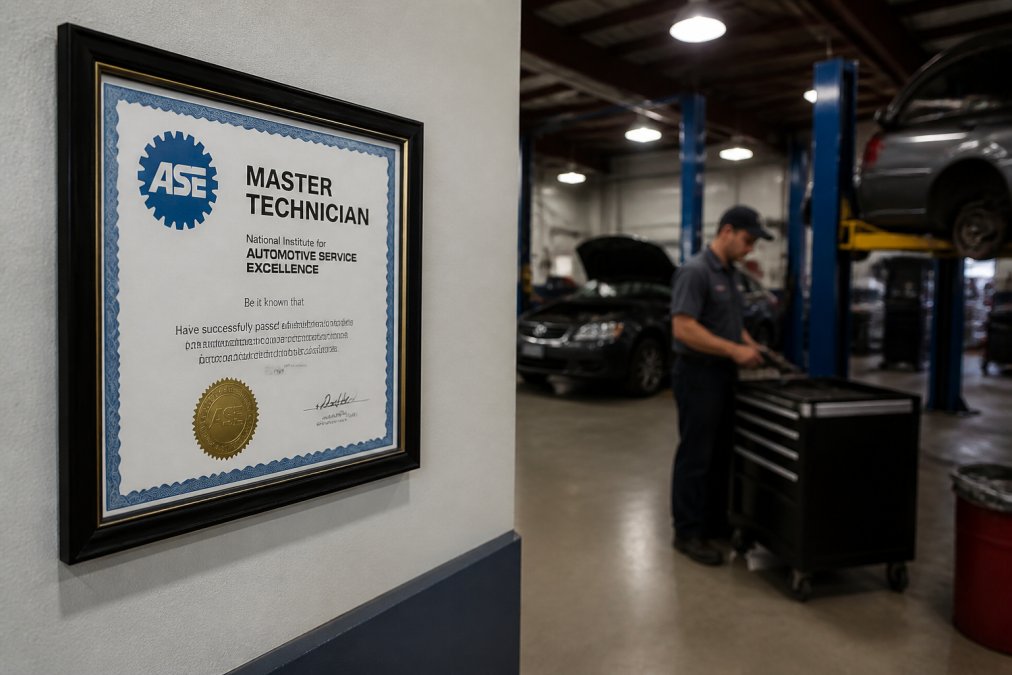
When you visit the shop, ask to see physical proof. Many shops display their certifications on the wall or in the office. A legitimate operation doesn't hide this information.
How to Spot a Real ASE Card
Ask the service advisor or shop manager to show you the technician's current ASE card. Here's what a genuine ASE Master Technician card contains:
Security features on a real ASE card:
- A hologram in the upper left corner that shifts color when tilted (blue to green to purple)
- A watermark of the ASE logo visible when held up to light
- Raised printing on the technician's name and certification level, you can feel the texture with your fingernail
- A microprint line along the bottom edge that reads "ASE" when magnified
- Thick, rigid card stock, not flimsy or thin
- A unique serial number printed on the back
- The expiration date in the lower right corner in a specific font
What a fake or altered card looks like:
- Flat, glossy printing with no raised texture
- Blurry or pixelated hologram, or no hologram at all
- Watermark that's too dark, too light, or missing
- Thin cardstock that bends easily
- Inconsistent fonts or spacing
- Expiration date that's been altered or looks overwritten
- Serial number that doesn't match the standard format
Requesting Documentation
Request a copy of their certification to keep with your service records. A reputable shop will provide this without hesitation. Ask which specific systems the technician is certified in. A Master Certified tech should confidently name all eight areas: engine repair, automatic transmissions, manual drivetrains, suspension and steering, brakes, electrical systems, heating and air conditioning, and engine performance.
Checking for Manufacturer-Specific Certifications
Common manufacturer certifications include:
- Toyota Certified Technician (T-TEN program)
- Ford Certified Technician (Ford FACT program)
- General Motors Service Technician Certification
- BMW Technician Certification
- Mercedes-Benz Technician Certification
- Audi/Volkswagen Technician Certification
- Honda Technician Certification
At Euro Specialist, we display our Master Certified technicians' credentials openly because we stand behind their qualifications. Transparency builds trust, and honest shops have nothing to hide.
Questions to Ask a Mechanic Before Service
The right questions reveal whether someone knows their craft or is just going through the motions.
Ask about their diagnostic fee. Know the cost upfront.
Red Flags: How to Spot Fake or Expired Credentials
Knowing what to watch for protects you from dishonest shops that misrepresent their technicians' qualifications.
Expired Certifications
Expired certifications are the most common problem. A technician's ASE card expires every five years (FAQs). If their certification lapsed in 2024 and it's now 2026, they're no longer certified.
How to verify expiration:
- Check the ASE database lookup, it clearly marks active versus inactive certifications
- Look at the physical card's expiration date in the lower right corner
- Ask the shop directly: "When does this technician's certification expire?"
- Request proof of renewal if the card is approaching expiration
Vague Credential Language
Shops sometimes use deliberately misleading language to inflate their technicians' qualifications.
Language that does NOT mean certified:
- "ASE trained" (means they took a training course, not that they passed the exam)
- "ASE educated" (same as trained, no certification exam passed)
- "ASE approved" (no such official designation exists)
- "ASE recommended" (not an official credential)
- "Working toward ASE certification" (they haven't passed the exam yet)
- "ASE affiliated" (vague and meaningless)
Language that DOES mean certified:
- "ASE certified" or "ASE Master Certified" (they passed the exam)
- "Holds current ASE certification in [specific area]" (they passed and it's active)
- Specific manufacturer certification names (e.g., "BMW Technician Certified")
Inability to Produce Physical Credentials
A shop with no visible credentials displayed is a warning. Reputable shops proudly display their technicians' certifications in the waiting area or office.
How to test this:
- When you call to schedule, ask: "Can you show me your technicians' ASE certifications when I come in?"
- Look around the waiting area and office for framed certificates
- If you ask to see a specific technician's card and the shop can't produce it within a few minutes, the credential likely doesn't exist
Inconsistencies Between Claims and Databases
Compare what the shop claims against what you find in official databases.
Red flags that indicate dishonesty:
- The shop's website lists five Master Certified technicians, but the ASE database shows only two
- A technician claims to be certified in eight areas, but the ASE lookup shows only three
- The shop claims a technician has been certified since 2010, but the ASE database shows they were first certified in 2020
- The technician's name on the shop's website doesn't match the name in the ASE database
- The shop lists certifications the technician doesn't actually hold
Vague Responses to Technical Questions
A certified technician should be able to explain their expertise confidently. Ask specific questions about your vehicle's systems and listen for detailed explanations mentioning specific procedures, tools, and potential complications. If they give vague answers like "we'll run some tests," they may not actually understand the work.
Pressure to Approve Work Without Diagnosis
A legitimate diagnostic process takes time.
Warning signs:
- The shop quotes a repair price without performing diagnosis first
- They pressure you to approve work "so we can get started"
- They won't give you a written estimate before beginning
- They claim diagnosis will take "just a few minutes" for a complex problem
- They refuse to explain their diagnostic steps
Refusal to Provide References or Warranty
A shop that stands behind its work offers a warranty and can provide customer references.
Ask these questions:
- "What warranty do you offer on repairs?"
- "Can you provide references from customers with similar vehicles?"
- "What happens if the same problem returns after I leave?"
- "Do you guarantee your diagnostic accuracy?"
Frequently Asked Questions
How do I check if a mechanic is ASE certified?
Visit the ASE website and use their technician search tool. Enter the mechanic's name or shop name to verify current certification status. ASE certification lookup results show which certifications they hold, their expiration dates, and any disciplinary history. You can also ask the shop directly for their technician's ASE card or certificate number to cross-reference.
What does ASE master certified mean?
ASE Master Technician certification means a mechanic has passed at least eight ASE certification exams covering different vehicle systems (engine, transmission, brakes, electrical, etc.) and has two years of professional work experience. Master Technician status demonstrates advanced technical proficiency across multiple automotive repair areas and ongoing commitment to professional development through recertification every five years.
Does a master mechanic certification expire?
Yes, ASE Master Technician certification expires every five years. Technicians must pass recertification exams to maintain their credentials. When verifying a mechanic's certification, always check the expiration date on their certificate or through the ASE lookup tool to ensure their credentials are current and valid.
What questions should I ask a mechanic before service?
Ask about their certifications and how long they've worked on your vehicle's make, ask what diagnostic process they'll use, and request service records from previous work. These questions help you understand their technical competence and service quality before committing to repairs.