 How-to
7 Steps to Find Hidden Car Electrical Shorts
Last Updated: November 14, 2026
Quick Summary
To find hidden car electrical shorts, first identify the fault type: a fuse that blows instantly points to a short circuit, while a battery that dies over 1 to 3 days points to a parasitic draw. Then use a multimeter to run a battery draw test and pull one fuse at a time until the draw drops sharply, which isolates the circuit.
- A fuse that blows twice points to a live fault in that circuit, not a bad fuse.
- Wait 30 to 60 minutes for modules to sleep before measuring current draw.
- A healthy car draws a few milliamps to about 50 mA after sleep.
- Wiggle connectors while watching the meter; a jumping reading means the fault is there.
- Never probe orange high-voltage hybrid and EV cables; leave them alone.
Table of Contents
- Electrical Short in Car Symptoms: What You'll Notice First
- Tools and Safety Gear for Finding Car Electrical Shorts
- How to Find a Short in a Car with a Multimeter
- How to Find a Short in a Car with a Test Light
- How to Find a Short in a Wiring Harness
- Modern Vehicle Precautions and When to Stop DIY Diagnosis
- Schedule a Professional Electrical Diagnostic
- Frequently Asked Questions
Electrical Short in Car Symptoms: What You'll Notice First
Learning how to find hidden car electrical shorts starts with recognizing the warning signs. An electrical short is an unintended path where current bypasses the normal circuit and flows directly to ground. Drivers who ignore early clues often end up stranded.
Here is what usually shows up first:
- A fuse that blows again right after you replace it
- A burning plastic or hot metal smell near the dash or fuse box
- A battery that dies overnight, even when everything is switched off
One blown fuse is normal wear. The same fuse blowing twice is a short circuit asking for attention.
Blown Fuses, Burning Smells, and Dead Batteries
A fuse is a sacrificial part. It melts to protect the wiring, so a fuse that keeps failing points to a live fault in that circuit, not a bad fuse. A burning smell is more urgent.
A dead battery is the most misread symptom. If your battery keeps dying, a battery service visit can test both the battery and the draw behind it.
Short Circuit vs. Parasitic Draw vs. Normal Module Activity
These three problems look alike but need different fixes. A short circuit is a fault that dumps current to ground, often blowing a fuse. A parasitic draw is a small, steady drain that kills the battery over hours or days. Normal module activity is the small current modern computers pull while asleep, and it is not a fault.
Here is how to tell them apart:
| Symptom | Likely Cause | First Check |
|---|---|---|
| Fuse blows instantly | Short circuit | Inspect that circuit's wiring |
| Battery dies over 1-3 days | Parasitic draw | Measure current draw with a multimeter |
| Battery dies over weeks | Weak battery or small draw | Load-test the battery first |
| Small draw that drops after 30-60 minutes | Normal module sleep | Recheck after modules go to sleep |
Tools and Safety Gear for Finding Car Electrical Shorts
You need a few basic tools to trace car electrical shorts safely. Nothing here is exotic, but each item has a job.
- Digital multimeter with a 10A current setting and a continuity mode
- Test light for quick voltage checks
- Fused jumper wire for bypass tests without risking a meltdown
European cars often use special fasteners and dense wiring, which is why European cars need specialized tools for many jobs.
Watch out: never probe a circuit with the battery connected unless your meter is rated for it. A careless probe can fry a control module that costs far more than the diagnosis.
How to Find a Short in a Car with a Multimeter
The multimeter is the core tool for finding a short in a car because it measures voltage, resistance, and current, which covers every test below. The difference between a useful reading and a wasted afternoon is how you set up the meter and where you connect it. Follow this sequence exactly, and record every reading so you can compare before and after a repair.
Multimeter Setup, Connection Points, and Expected Readings
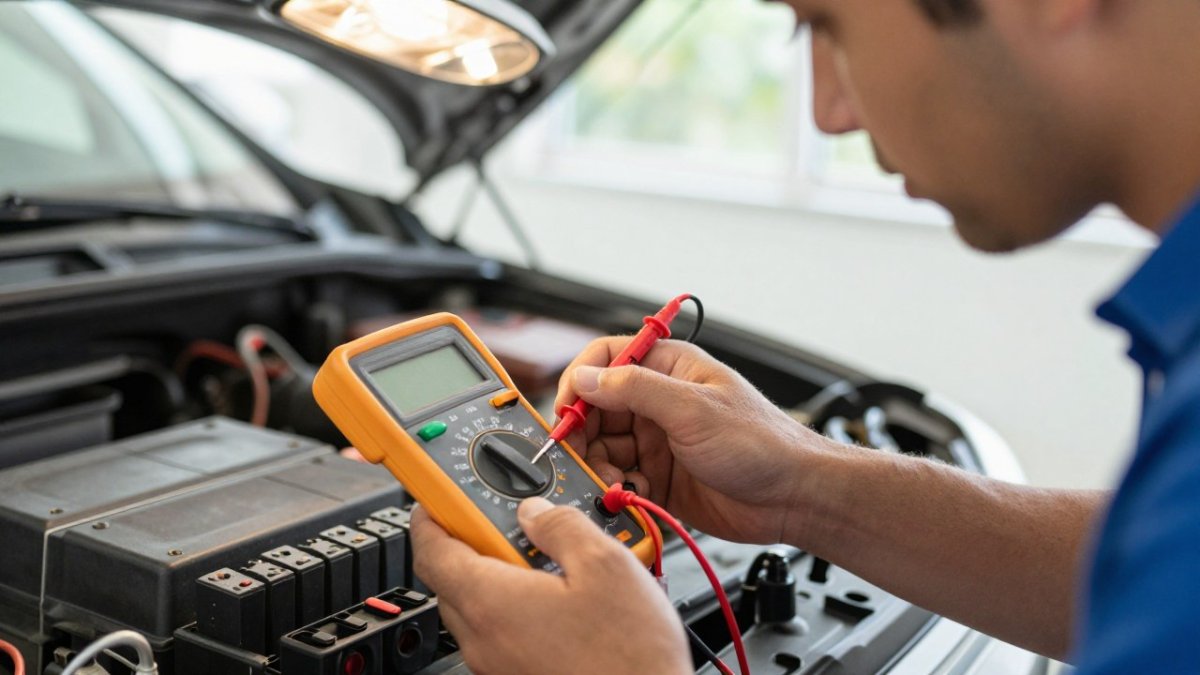
Start with the meter off, the key out, and the battery negative cable still connected. Plug the black lead into COM. For voltage and continuity tests, plug the red lead into the V/Ω jack.
Expected readings on a healthy vehicle:
- Battery at rest: about 12.6V at 70°F on a fully charged lead-acid battery. Below 12.4V, charge the battery before any draw test.
- Continuity: near 0 ohms on a good wire, and no beep on a broken one. Disconnect the circuit before testing resistance so you do not read through a module.
- Current draw after sleep: a few milliamps to roughly 50 mA on many vehicles, depending on how many modules stay awake. A draw above about 50 mA after the sleep window is worth isolating.
Battery Draw Test and Fuse-by-Fuse Isolation
A battery draw test finds a parasitic drain. A fuse-by-fuse check narrows it to one circuit. Do them in this order so you do not chase a draw that is really a short.
- Charge the battery fully and let the car sit with all doors closed, the key out, and every accessory off.
- Wait 30 to 60 minutes so modules go to sleep. On some vehicles the sleep window is longer; check the owner's manual or a factory service procedure if the draw stays high.
- Set the meter to the 10A current range and connect it in series between the negative battery terminal and the negative cable. Do not open the door or touch the key while the meter is in series.
- Note the reading. A healthy car draws a few milliamps to about 50 mA after sleep.
- Pull one fuse at a time and watch the meter. Reinstall each fuse before pulling the next.
- When the draw drops sharply, you found the circuit. Note the fuse number and the components it feeds.
Watch out: opening a door or touching the key fob wakes modules and spikes the reading, so keep the meter where you can see it and work through the fuse box without disturbing the cabin.
Decision Tree: Short Circuit, Parasitic Draw, or Normal Module Activity
Use this order before you probe anything. It prevents testing the wrong fault.
- Does a fuse blow instantly when installed? That is a short circuit to ground in that circuit. Go to the fuse-by-fuse isolation and then trace the harness between the fuse and the load.
- Does the battery die over 1 to 3 days with everything off? That is a parasitic draw. Run the battery draw test above and isolate the circuit by fuse.
- Does the battery die over weeks? Load-test the battery first. A weak battery can mimic a small draw.
If the draw is high but no single fuse changes it, the fault may be in an unfused circuit, a module that stays awake, or a relay that is stuck closed. In that case, move to the harness and relay checks rather than pulling more fuses.
How to Find a Short in a Car with a Test Light
A test light finds a short in a car fast when a fuse keeps blowing.
Clip the test light to a good ground, then touch the probe to the fuse contacts with the key on.
For a fuse that blows instantly, unplug the load at the end of the circuit and retry. If the fuse holds, the fault is in the load.
How to Find a Short in a Wiring Harness
Tracing a short in a wiring harness is where patience pays off. The fault hides under insulation, inside a loom, or at a connector pin.
- Follow the wire along its route and look for chafing against metal brackets, sharp edges, and body seams.
- Check where the harness bends near hinges, seats, the trunk, and the steering column.
- Wiggle connectors while watching the meter. A reading that jumps means the fault is at that connector or the wire just behind it.
A tone generator and probe, sometimes called a Fox and Hound, helps you follow a wire without cutting into it. Connect the transmitter at one end of the suspect wire with the circuit off, then trace the tone with the probe.
Intermittent Faults: Movement, Heat, Moisture, and Vibration
An intermittent short only shows up under certain conditions. The trick is to recreate those conditions while you watch the meter, one variable at a time, so you know which one triggers the fault.
- Movement: flex the harness by hand, section by section, and watch for a change in reading. Mark the spot where the reading jumps.
- Heat: warm a suspect area with a hair dryer, never an open flame, and watch the meter as the area heats.
- Moisture: mist water on a suspect connector and check for a change. Dry it fully before moving on.
A common pattern is a fault that appears only on cold mornings or only after the cabin warms up. Note the conditions when the fault appears and try to reproduce them in that order.
Circuit Diagrams, Fuse-Box Maps, and Safe Circuit ID
A wiring diagram turns guesswork into a plan. It shows wire colors, connector pins, and grounds, so you know which wire does what before you probe it.
Watch out: probing a wire that feeds a control module can back-feed voltage into the module and damage it. Confirm the circuit on the diagram before you touch a probe to any pin.
Modern Vehicle Precautions and When to Stop DIY Diagnosis
Modern cars add risk that older cars did not have. High-voltage hybrid and EV systems carry lethal voltage, and you should never probe those cables. Leave orange high-voltage wiring alone.
Modules also need stable voltage. If you own a European car with complex electronics, our guide on troubleshooting electrical issues in European cars covers the extra steps these models need.
Stop and call a professional when:
- The fault is intermittent and you cannot recreate it
- The short is in a high-voltage system
- Multiple modules set codes at once
That is where we come in.
Schedule a Professional Electrical Diagnostic
Chasing a hidden short can eat a weekend and still leave you guessing. Every job is backed by a warranty on our work.
You can book an electrical diagnostic and let us trace it properly. Prefer to talk first? Our contact page has the details to reach our team.
A short you cannot find is not a mystery you have to solve alone.
Frequently Asked Questions
What is the easiest way to find an electrical short in a car?
Start with the fuse box. Remove one fuse at a time and watch the multimeter current draw; when the draw drops, you have isolated the circuit. Then inspect that circuit's wiring and components for damaged insulation or a short to ground. A test light can confirm power at fuses and relays. For intermittent shorts, wiggle harnesses and connectors while watching the meter. If the short persists after fuse isolation, professional diagnosis with a wiring diagram is the next step.
How do you find a short to ground in a car?
Set your multimeter to continuity or resistance. Disconnect the battery negative terminal. Connect one probe to a clean chassis ground and the other to the suspected circuit's ground wire or connector pin. A near-zero reading indicates a short to ground. For live testing, use a test light between the battery positive and the suspected ground point; a bright light means a direct short. Always consult the wiring diagram for your make and model before probing.
What are the symptoms of an electrical short in a car?
Common electrical short in car symptoms include repeatedly blown fuses, a battery that dies overnight, burning smells, flickering lights, malfunctioning accessories, and a current draw that stays high after the vehicle sleeps. A short circuit often causes a sudden failure, while a parasitic draw drains the battery slowly. Distinguishing between the two with a multimeter draw test saves time and prevents replacing parts that are not faulty.
When should you take a car to a professional to diagnose an electrical short?
See a professional when the short involves high-voltage hybrid or EV systems, when multiple circuits are affected, when the fault is intermittent and you cannot reproduce it, or when fuse isolation points to a module that requires coding. Master-certified technicians have factory wiring diagrams, circuit tracers, and scan tools to locate faults without guesswork. If you have replaced fuses and checked the battery without success, a professional diagnostic prevents further damage.