 blog
EuroPauto vs Dealer Service Alternative: Full Comparison
Quick Summary
EuroPauto and Dealer Service Alternative are both repair shop options, and the article says a shop's label does not guarantee its capability for your car. Verify each provider's makes, models, diagnostic tools and written estimates before booking, when comparing europauto vs dealer.
- Ask which European makes the shop services and whether it has worked on your engine and model year.
- Ask whether the shop can perform manufacturer-level coding and adaptations for your model.
- Request a written estimate on a real job for your car before approving any work.
- Compare labor rate, billed labor time, parts markup and diagnostic fees line by line.
- Check review patterns for repeated misdiagnosis or repeat visits, not just star averages.
Table of Contents
- What EuroPauto and Dealer Service Alternative Each Offer
- Independent European Auto Repair vs Dealership: Where the Real Differences Are
- Transparent Pricing and European Auto Repair Cost Comparison
- Technician Experience, Certifications and Diagnostic Capability
- Warranty Coverage and Service Records
- How to Choose a European Auto Repair Shop for Your Situation
- Booking Your Next European Vehicle Service
- Frequently Asked Questions
What EuroPauto and Dealer Service Alternative Each Offer
Last Updated: October 28, 2026
When comparing repair shops, verify the specifics for your own vehicle.
The structural difference
Neither label guarantees capability. The label tells you what the shop intends to be; the questions below tell you what it actually is for your car.
Service coverage to verify for each
Consider these coverage questions when evaluating a repair shop:
- Routine maintenance. Oil and filter service, brake inspection, tire rotation, fluid checks, and scheduled-interval items. Confirm the shop uses the oil specification and interval your owner's manual requires.
- Diagnostics. Check-engine and warning-light diagnosis, electrical fault tracing, and module scanning. Ask which scan tools the shop uses and whether it can perform manufacturer-level coding and adaptations for your model.
- Major mechanical work. Timing chains and belts, turbo and supercharger service, cooling-system repair, and transmission service. Confirm the shop's experience on your specific engine family, not just the brand.
- European-specific systems. Direct injection, variable valve timing, air suspension, and the electronic modules that control them. Ask the shop about its capabilities with these systems.
Ask directly: "If my car needs module coding after a battery replacement, can you do it here?"
How to verify either provider before you book
Use these questions to verify a repair shop before booking:
- Confirm the makes and models. Ask which European makes the shop services and whether it has done work on your specific engine and model year.
- Ask about tooling and software. Ask the shop which diagnostic platform it uses and whether it can perform coding and adaptations.
- Request a sample estimate. Ask for a written estimate on a real job for your car.
- Check review patterns, not star averages. Look for repeated comments about misdiagnosis, repeat visits, or unexplained charges, and note the dates of the reviews.
Our services page lists services we offer, including preventative maintenance, A/C service, and engine repair.
Independent European Auto Repair vs Dealership: Where the Real Differences Are
Many owners ask whether an independent European shop is really different from a dealership. Differences can include who does the work, how it is priced, and how much attention the car receives.
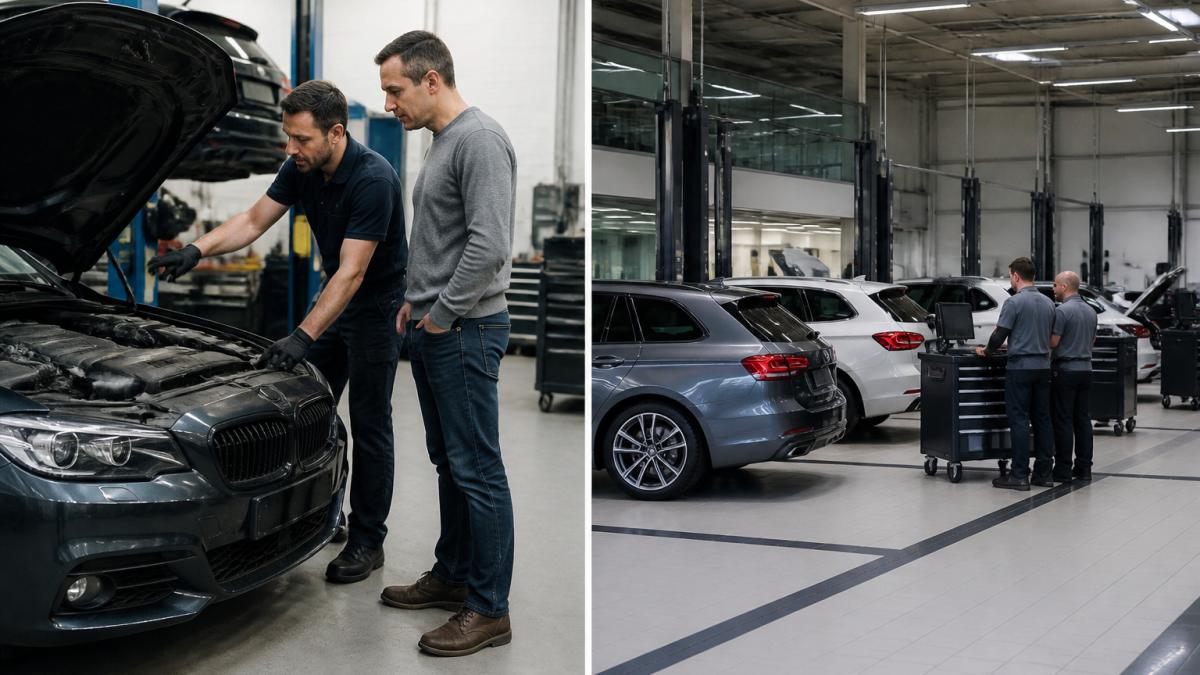
Ask whether a specific shop can demonstrate the capabilities needed for your model and year.
The right choice depends on the repair in front of you.
Transparent Pricing and European Auto Repair Cost Comparison
When evaluating repair costs, ask how the shop builds an estimate and what it discloses before you approve the job.
The three numbers that actually drive your bill
When reviewing an estimate, consider these three inputs separately rather than comparing only the bottom-line figure.
- Labor rate. Ask for the shop's hourly labor rate in writing. The rate alone tells you little until you know the billed hours.
- Billed labor time. Ask whether the shop bills from a published labor-time guide or from actual clock time.
- Parts markup and sourcing. Ask which parts the shop uses.
Diagnostic fees: credited or not
Ask whether the shop charges a diagnostic fee before authorizing a repair.
Ask the shop whether any diagnostic fee is credited toward a repair, and what happens if the diagnosis is inconclusive.
How to compare two quotes without published prices
For a comparison, request estimates for the same repair on the same vehicle. Then consider:
- Labor rate and billed hours.
- Parts and parts price.
- Any diagnostic fee.
- Any additional fees.
- Warranty terms on parts and labor.
Comparing line items can help show how each estimate is structured.
Watch for these pricing patterns
- Maintenance recommendations. Ask which items are mileage-based and which are inspection-based.
- Fluids and filters. Request the manufacturer's interval for each fluid before approving a flush.
- Fees for intermittent faults. If a car must stay for a hard-to-reproduce problem, ask about any applicable fees.
Ask the same questions of each shop and compare the answers.
The article names three inputs that drive a repair bill; this table lists them so you can compare estimates line by line.
| Cost input | What to ask for | Why it matters |
|---|---|---|
| Labor rate | Hourly labor rate in writing | Rate alone tells you little |
| Billed labor time | Published labor-time guide or clock time | Determines the billed hours |
| Parts markup | Which parts and how they are sourced | Affects the parts price |
| Diagnostic fee | Whether it is credited toward the repair | Affects total cost if inconclusive |
Technician Experience, Certifications and Diagnostic Capability
Ask what certifications the technicians hold. To understand what a professional engine diagnostic involves and what it costs, see professional engine diagnostic guide.
Ask the shop how it would investigate a specific symptom on your car, such as a warning light that comes and goes. You can read what other customers say about this kind of work in European auto repair shop reviews.
Warranty Coverage and Service Records
Ask the shop what its warranty covers and whether it applies to parts, labor, or both.
Keep service records for your car.
Manufacturer warranty coverage is a separate question. Check your warranty booklet before deciding where to have a covered repair done.
How to Choose a European Auto Repair Shop for Your Situation
The right shop depends on what you need.
Distance matters too. Weigh the time and cost of travel when choosing a shop. If you are considering a longer trip, see whether travelling for luxury car service is worth it.
Use a short checklist when you evaluate a shop:
- Ask whether the shop specializes in your make and model.
- Ask how the shop would diagnose a specific symptom.
Booking Your Next European Vehicle Service
Our oil change service page provides information about our oil change service.
Bring your service records and a note of any symptoms you have noticed, including when they happen. Schedule your appointment and ask the questions in this guide.
Frequently Asked Questions
Is an independent European auto repair shop as good as a dealership?
When evaluating a shop, ask about its experience with your specific make and the capabilities needed for your car. Ask how it handles recall work and software-level updates before you book.
Is it cheaper to service a European car at an independent shop?
Pricing depends on the service, the vehicle, and the parts used. Ask the shop for a quote.
What should I compare when choosing a European auto repair shop?
Ask about the shop's experience with your make and diagnostic capabilities. Ask what its warranty covers and how it explains estimates.
What questions should I ask before approving a European car repair?
Ask what the diagnosis is based on and what the warranty covers if the problem returns. Ask which parts are being used.