 how-to
Audi Electrical Diagnostics in Winter Park, FL
Table of Contents
- How Audi Electrical Diagnostics Works: A Step-by-Step Process
- Audi Battery and Charging System Diagnosis
- Audi Warning Light Diagnosis: What Each Signal Tells You
- Audi Parasitic Battery Drain Diagnosis: Finding the Hidden Draw
- Safe Checks You Can Do Before Scheduling Audi Electrical Diagnostics
- What to Expect: Pricing, Turnaround, and Choosing a Shop in Winter Park
- Why Euro Specialist for Audi Electrical Diagnostics in Winter Park
- Frequently Asked Questions
Last Updated: October 13, 2026
How Audi Electrical Diagnostics Works: A Step-by-Step Process
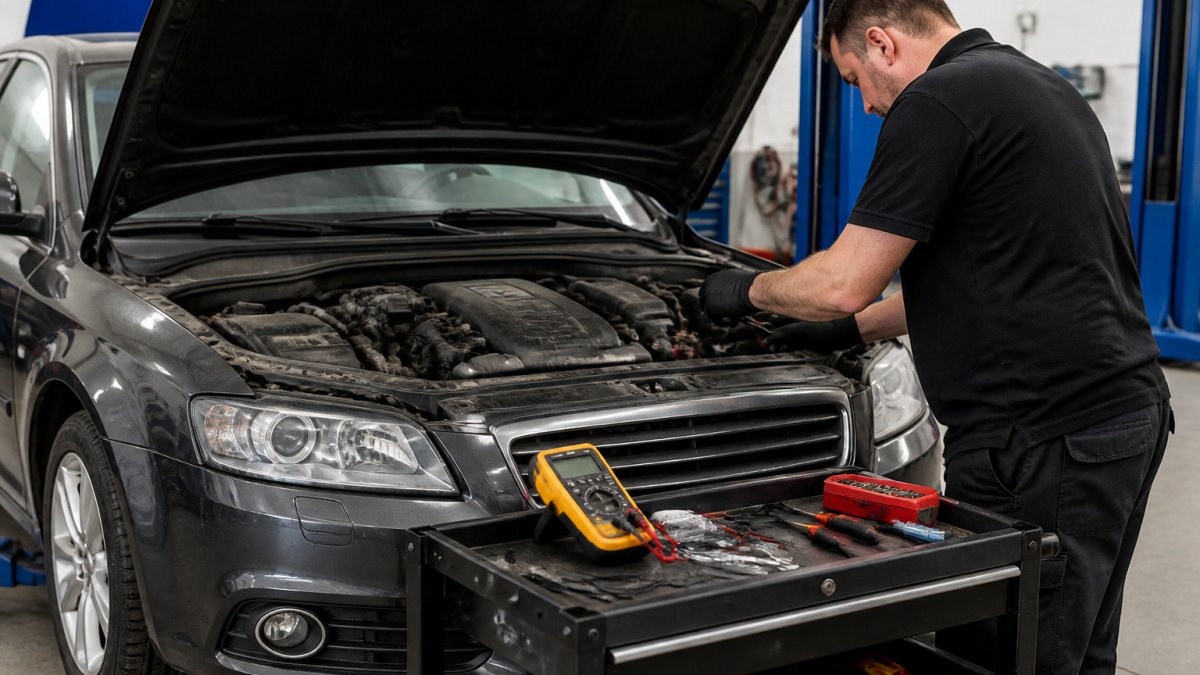
When your Audi's dashboard lights up like a warning panel, guessing at the cause wastes time and money. Audi electrical diagnostics is the systematic process of using scan tools and circuit tests to trace a fault to its source, and at Euro Specialist, we follow a structured approach that starts with data, not guesswork. Below, we break down exactly how a proper diagnostic inspection unfolds, so you know what to expect before you hand over your keys.

Step 1: Pull Fault Codes With a Scan Tool
Modern Audis run dozens of control modules, and each one stores its own fault codes when something misbehaves. A technician connects a scan tool to the OBD-II port and reads every module, not just the engine. This matters because a fault in the comfort module can trigger symptoms that look like an engine problem. The scan gives direction, not a final answer. A fault code tells you which circuit to investigate, and the real work begins with testing.
Step 2: Test Circuits, Relays, and Fuses
A code pointing to a circuit does not mean the component is bad. Technicians test voltage, resistance, and continuity at the fuse box, relays, connectors, and grounds before replacing anything. This step separates a failed sensor from a chafed wire or a corroded ground strap. Skipping it is the most common mistake we see from shops that throw parts at a problem. A $20 relay can mimic a $900 module failure, and only circuit testing tells them apart.
Audi Battery and Charging System Diagnosis
A weak battery or failing alternator causes more electrical complaints than any other single fault. Audi battery and charging system diagnosis starts with a load test on the battery, then checks alternator output and the charging circuit under load. Many batteries fail gradually, so a car may start fine in warm weather and leave you stranded on a cold morning. If your Audi cranks slowly, dims its lights at idle, or shows a battery warning, get the charging system tested before it strands you. Our battery service covers testing and replacement.
Audi Warning Light Diagnosis: What Each Signal Tells You
Warning lights are the electrical system's way of telling you where to look first, but the symbol on the dash rarely names the actual fault. Audi warning light diagnosis pairs each illuminated symbol with the control module that set it, then reads the stored fault codes inside that module to narrow the search. Two Audis can show the same amber icon and have completely different root causes.
Here is how the common signals map to modules and next checks:
- Check engine light (steady), Set by the engine control module (ECM). Codes in the P0xxx range point to powertrain and emissions circuits; a loose gas cap, a failing oxygen sensor heater circuit, or a misfire on one cylinder can all trigger it. A steady light means you can drive to a shop; a flashing check engine light means active misfire that can damage the catalytic converter, stop driving.
- Battery / charging icon, Set by the charging system or the gateway module monitoring system voltage. Points to the alternator, the belt, the voltage regulator, or a corroded charging cable. Test alternator output under load, not just at idle.
- EPC (Electronic Power Control), Common on Audi. Set by the ECM or throttle control module. Often traces to a throttle body, an accelerator pedal sensor, or a wiring fault in that circuit, not always the part itself.
- Airbag / SRS, Set by the restraint control module. Requires a scan tool to read and clear. A disconnected seat connector under a seat, a clock spring, or a low-voltage event can all set it. Never probe SRS wiring yourself.
- ABS / traction, Set by the ABS module. Wheel speed sensor circuits, tone rings, and harness chafe near the wheel wells are frequent causes.
- Tire pressure (TPMS), Set by the TPMS module. Often a dead sensor battery rather than an actual pressure problem.
Never ignore an intermittent warning light. Intermittent faults often trace to a loose connector, a chafed harness, or a failing ground, and they get worse, not better. Note when the light appears, cold start, after rain, at idle, while turning, because that pattern is often the fastest clue a technician has.
Audi Parasitic Battery Drain Diagnosis: Finding the Hidden Draw
A car that dies overnight has a parasitic draw, and finding it takes patience. Audi parasitic battery drain diagnosis measures current flow while the vehicle sleeps, then isolates circuits one at a time until the draw disappears. Normal sleep current on most Audis is tiny, so even a small drain from a stuck relay or a module that won't power down can kill a battery in a day or two. This test can take hours because the car must fully enter sleep mode first. A technician who rushes it will misdiagnose the fault. Expect this job to be billed by diagnostic time, not by the part.
Safe Checks You Can Do Before Scheduling Audi Electrical Diagnostics
You can rule out a few simple causes yourself before booking a service visit. These checks are safe, require no tools beyond a flashlight and a multimeter if you own one, and give the technician better information when you arrive:
- Battery terminals, Confirm they are tight and free of white or green corrosion. Corrosion adds resistance that mimics a weak battery.
- Battery cables, Check that cables are not loose or frayed at the clamps. A loose ground can cause random module faults.
- Fuses, Look for obvious blown fuses in the under-hood and interior fuse boxes. Match the amperage rating printed on the fuse; never substitute a higher-rated fuse.
- Battery voltage (if you have a multimeter), A healthy, rested battery reads about 12.6 volts. Below 12.2 volts suggests a weak or discharged battery. With the engine running, you should see roughly 13.5 to 14.5 volts at the battery, lower can indicate a charging problem.
- Symptom log, Note exactly when the fault happens: cold start, after rain, at idle, or while turning. Write down every warning light and any recent work done on the car.
What to Expect: Pricing, Turnaround, and Choosing a Shop in Winter Park
Diagnostic pricing depends on the fault, the time required, and how deep the technician has to dig. Turnaround depends on parts availability and fault complexity. When choosing a shop, ask three questions: Do they use dealer-level scan tools? Do they test circuits or just replace parts? Is the work warrantied? A shop that answers all three clearly is worth the drive.
Why Euro Specialist for Audi Electrical Diagnostics in Winter Park
Euro Specialist is a family-owned shop built around European vehicles. Our master-certified technicians work on all European makes, use dealer-level diagnostic equipment, and warranty every repair. If two other shops have already guessed at your Audi's electrical fault, we start over with a proper diagnostic process and show you what we find. Drivers from Winter Park and the surrounding area make the short drive to our Longwood shop because we explain the fault in plain language and only recommend the work your car actually needs. For complex electrical and mechanical diagnostics on European vehicles, this is the kind of shop you keep.
Frequently Asked Questions
What does an Audi electrical diagnostic include?
An Audi electrical diagnostic typically includes a scan tool check for fault codes. At Euro Specialist, every diagnostic is handled by master-certified technicians using dealer-level equipment.
How do I know if my Audi has an electrical problem?
Common signs include a battery that keeps dying, dim or flickering lights, a starter that cranks slowly, warning lights that come and go, or accessories like power windows and seats acting erratically. You might also notice a burning smell or hear clicking sounds from relays. Because Audi electrical systems are complex, these symptoms can point to a weak battery, a failing alternator, or a parasitic drain. If you see any of these, it's best to schedule Audi electrical diagnostics rather than wait, since small issues can leave you stranded.
Why does my Audi battery keep dying?
A battery that keeps dying usually points to one of three things: an aging battery that no longer holds a charge, a charging system problem like a weak alternator, or a parasitic drain that pulls power when the car is off. Audi models are known for having multiple control modules that can stay awake and drain the battery. A proper Audi parasitic battery drain diagnosis uses a multimeter to measure current draw and isolate the circuit responsible. Euro Specialist can test your battery and alternator.
How long does an Audi electrical diagnostic take?
Most Audi electrical diagnostics take time, depending on the complexity of the fault. Scheduling an appointment in advance helps us minimize wait times and get you back on the road faster.
Electrical gremlins rarely fix themselves, and a small fault today can leave you stranded tomorrow. Euro Specialist offers master-certified technicians, expertise across all European makes, and a warranty on every repair, so you get a real diagnosis instead of a guess. Schedule an appointment with Euro Specialist and get your Audi's electrical system tested by a team that treats your car like its own.